Filed Under:
New York’s Office of Deed Theft Prevention is one step toward justice for Black families
Families told Prism of their yearslong battles against LLCs that they say have used questionable practices to take ownership of their homes, which the companies deny
Real journalists wrote and edited this (not AI). Independent, community-driven journalism survives because you back it. Donate to sustain Prism’s mission and the humans behind it.
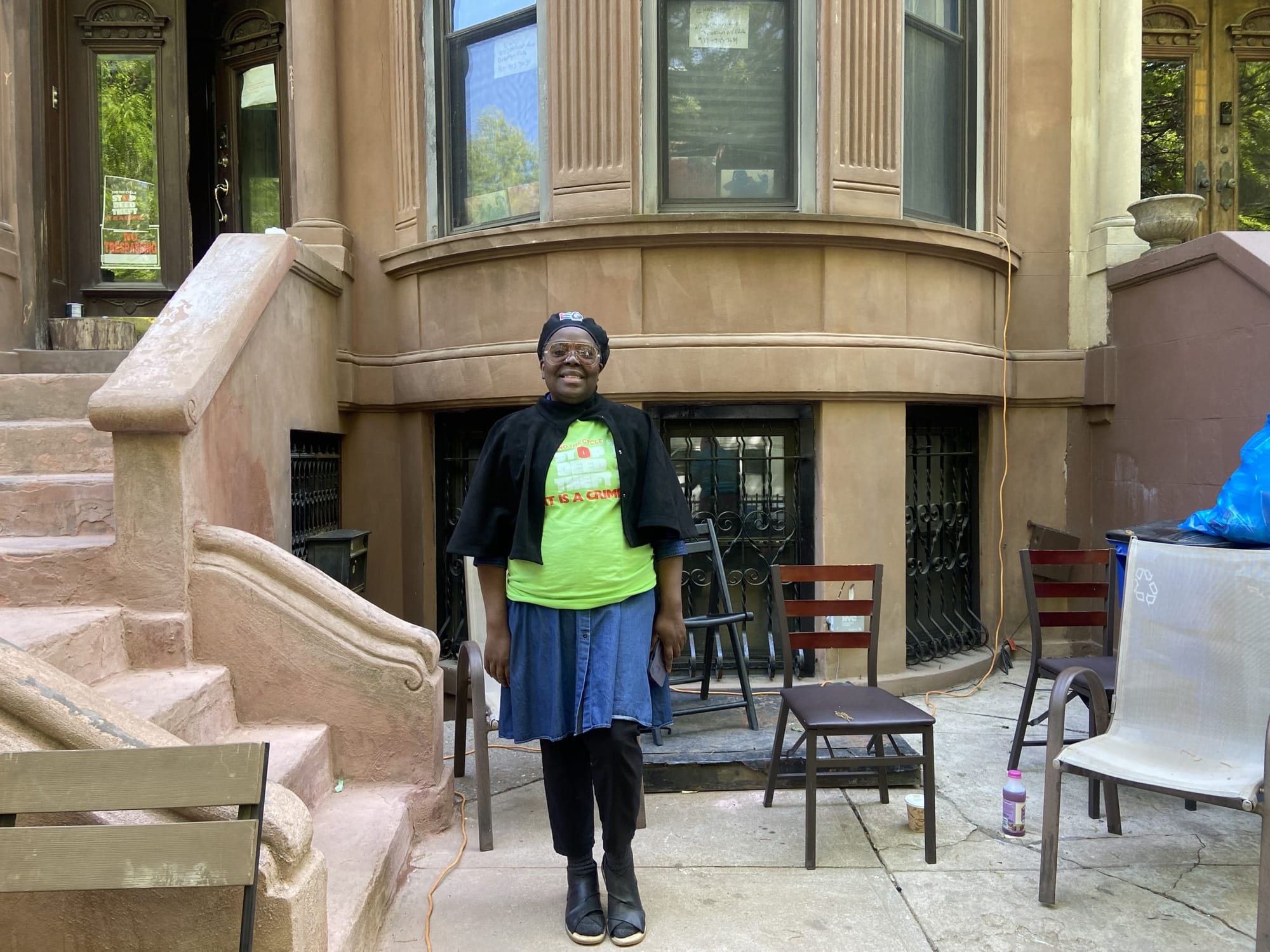
Carmella Charrington, 54, spent six days in Rikers Island jail after Civil Court Judge Rachel Freier sentenced her for failing to produce her father in court in a property dispute. Charrington told Prism that the judge dismissed the doctor’s note she brought to excuse her father’s absence due to him having COVID.
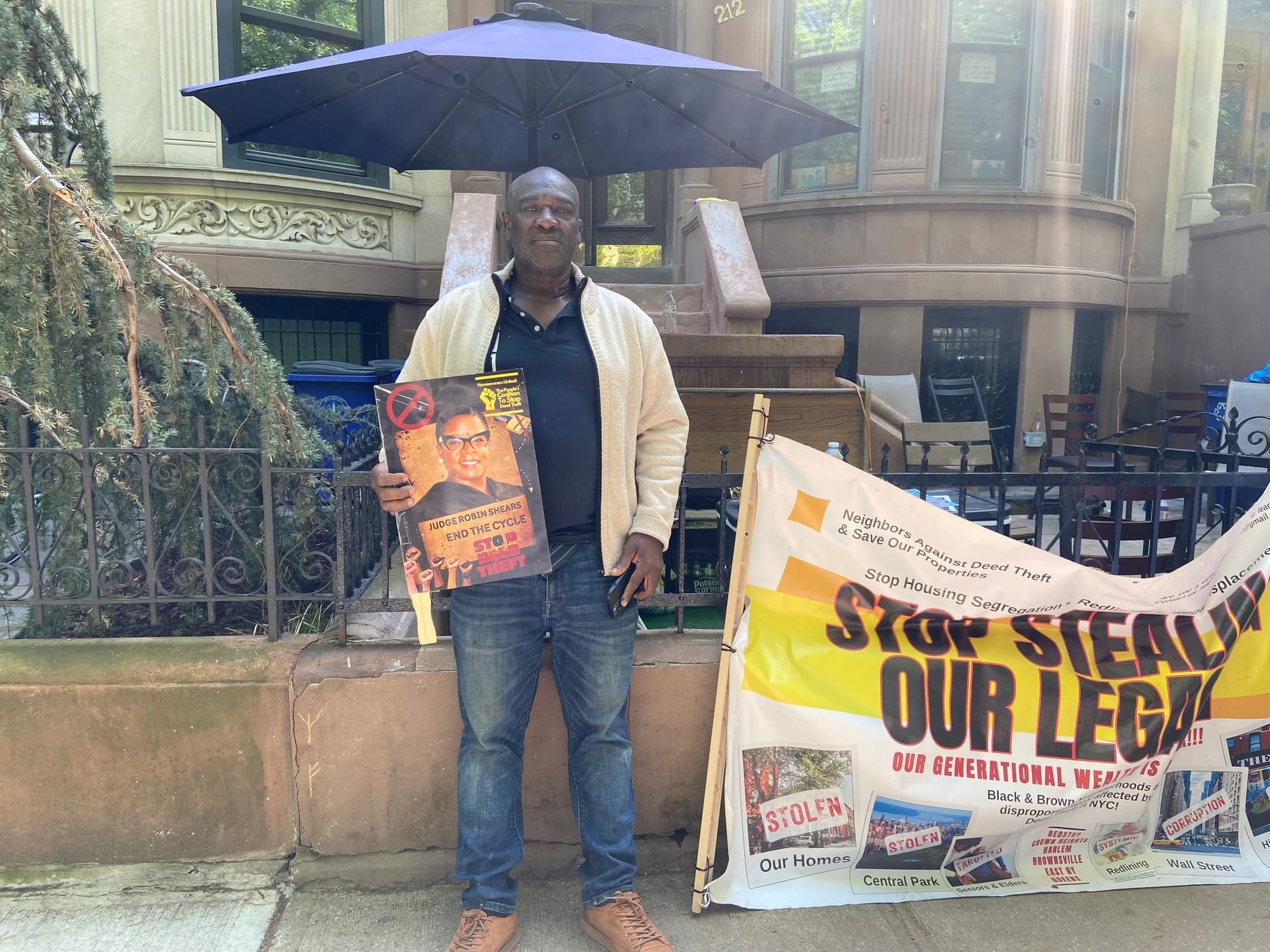
On April 22, the morning after Charrington’s release, city marshalls and sheriff’s deputies arrived at her family’s brownstone at 212 Jefferson Ave. in the Brooklyn neighborhood of Bedford-Stuyvesant to attempt an eviction. What followed was caught on video. New York City Council Member Chi Ossé, who had come to stand with Charrington, was handcuffed by police officers and later said he suffered a concussion.
The attempted eviction put Charrington’s case at the center of Brooklyn’s growing fight over deed theft. Charrington and her supporters say her family home was sold without her father’s approval. 227 Group LLC, which city records list as the current owner, denies their accusation, saying that the sale and eviction were lawful.
Two days after the chaos outside Charrington’s home, Mayor Zohran Mamdani announced the creation of New York City’s first Office of Deed Theft Prevention, appointing veteran housing attorney Peter White as its director.
“The theft of a home is the theft of a family’s future,” Mamdani said in a press release. “Deed theft preys on the New Yorkers who can least afford it.”
The office will be housed in the Department of Finance, and coordinate with city agencies. Mamdani said its budget is $500,000 this fiscal year, and $1 million next year. He had promised a $10 million budget for such an office during his mayoral campaign.
Deed theft is when someone gains control of a home through paperwork that the initial owner or family says was forged, misleading, unauthorized, or pushed through without proper notice. In New York City, the practice has landed hardest in Black and brown neighborhoods, a pattern rooted in what researchers call “heirs’ property,” the informal inheritance of homes passed down without wills or probate, which the Lincoln Institute of Land Policy has identified as leaving families “highly susceptible to loss” and making their home easy targets for forced partition sales.
Twenty-four states, plus Washington, D.C., and the U.S. Virgin Islands, have adopted the Uniform Partition of Heirs Property Act, which gives co-owners the right of first refusal before a forced sale and requires open-market pricing rather than auction. New York went further, passing a version in 2024 that bars investors from initiating the partition process altogether.
In 2025, New York Attorney General Letitia James announced the first criminal cases under New York’s new deed theft statute, which went into effect in November 2024, indicting two people accused of stealing the home of an 88-year-old widow receiving hospice care in Queens. That year, Brooklyn real estate investor Sanford Solny was convicted on 17 charges and sentenced up to seven years in prison for stealing deeds to 11 properties, targeting minority homeowners in foreclosure in neighborhoods including Bed-Stuy, East Flatbush, and East New York.
But even after the convictions, advocates say some victims have not recovered their homes. And for the families who have been fighting for years, the laws have not kept pace with enforcement.
“I’m glad they’ve taken some steps,” Charrington told Prism. “But I mean, the level [of] what it takes for them to listen to us is just …”
She didn’t finish her sentence.
A two-year legal battle
Central and Eastern Brooklyn have been at the center of a crisis that advocates say has been hollowing out Black homeownership for years. At a public event at Medgar Evers College last year, Zulema Blair, interim executive director of the Dubois Bunche Public Policy Center, said Black homeownership in Bed-Stuy has fallen from roughly 70% or 80% decades ago to around 50% today. According to data cited by the mayor’s office, more than 3,500 deed theft complaints were filed in New York City between 2014 and 2023, primarily in Brooklyn and Queens. Complaints rose to 517 in 2025, more than three times the 149 complaints filed in 2023.
“We’re being wiped away,” Charrington said.
The Bed-Stuy brownstone has been the Charrington family’s home for six decades, according to Charrington’s court records. City records show her father, Allman Charrington, owning interest in the brownstone dating back to at least the ’80s. Ownership was divided into shares between various extended family members for decades.
In 2021, a family member tried to sell the property to Brooklyn Gates LLC, run by brothers Elliot and Joseph Ambalo and their business partner Etai Vardi. However, the contract was canceled, apparently due to the complex nature of the family’s ties to the home, according to Vardi’s comments to the real estate website Brownstoner in 2024.
A 2023 investigation by The City found that LLCs affiliated with the Ambalos and Vardi had acquired fractional or full ownership interests in 119 properties across New York City, largely in Black and Latino neighborhoods.
In 2024, 227 Group bought the property at 212 Jefferson Ave. for $1.4 million. The deed lists multiple grantors, including extended family members and Luanne Bonnie, who for several years had been serving as the conservator for Allman Charrington, who has Alzheimer’s, at the request of his daughters. The role gave Bonnie authority over parts of his property and financial life.
Property records show 227 Group and Brooklyn Gates share the same address in Long Island City. 227 Group told Prism in a written statement that the shared address was a clerical error by a title company preparing a termination document, and that Brooklyn Gates had no business association with 227 Group.
Carmella Charrington, who lives at the house with her son and grandchildren, disputes whether the family home should have been sold under Bonnie’s authority. According to court records, Charrington said her father did not authorize the sale and that her family was never properly notified.
Bonnie did not respond to Prism’s request for comment.
227 Group called the deed theft allegation “unequivocally and factually false,” saying the property was purchased “in an arm’s-length, all-cash transaction with title insurance.”
The company said the conveyance of Allman Charrington’s share was authorized by the Fulton County Probate Court in Georgia, which also denied Carmella Charrington’s challenge to the sale, and that two Kings County Supreme Court justices in three separate hearings ruled in the company’s favor.
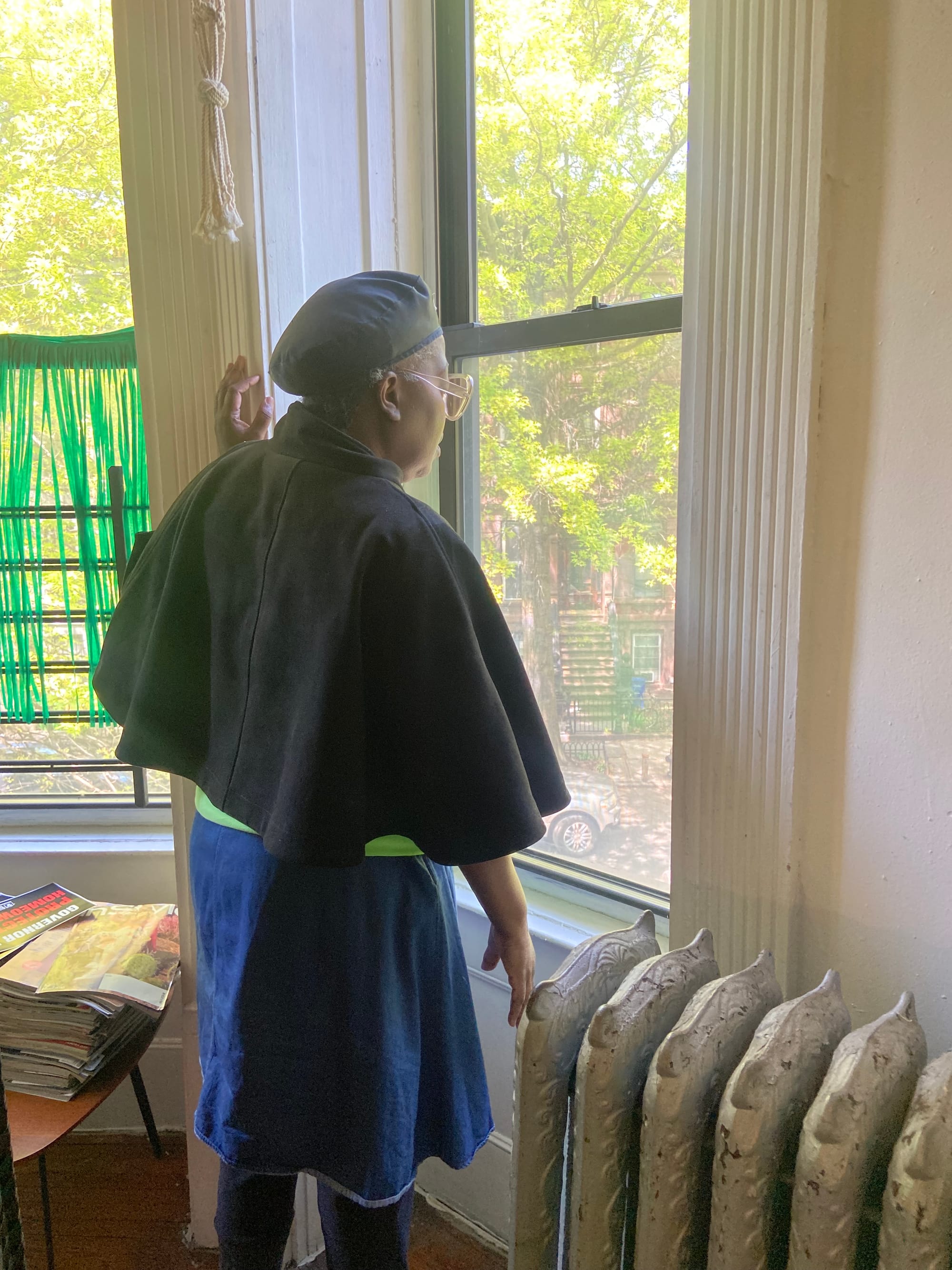
“The occupant, from the outset, has refused to vacate the property, which forced us to commence eviction proceedings,” the statement said, adding that Carmella Charrington had been living there “illegally” for over two years.
In January 2024, Charrington said that six men showed up at her home claiming to be the new owners. They had arrived with a truck to clean the house out.
Charrington said she refused to leave and called the police.
The incident launched the ongoing legal saga.
Charrington asked the Kings County Housing Court in March of this year to stop the eviction and dismiss the case, arguing that 227 Group LLC lacked standing to evict her. The court stayed the eviction warrant pending a hearing, allowing her to remain in the home while the dispute continued, but did not cancel the deed transfer. However, on April 6, she was again served a 14-day eviction notice.
On April 16, Charrington arrived for a court hearing without a lawyer. She asked for the case to be adjourned because her father had COVID and could not attend. Freier, the judge, did not grant her request and sent her to Rikers Island for contempt, where Charrington said conditions were “inhumane.”
The New York Attorney General’s Office said in an email it had reviewed the 212 Jefferson Ave. case in April 2025 and did not view it as deed theft, but as a property dispute involving competing claims from former owners. Charrington disputes that characterization.
Community support
Neighbors and members of the People’s Coalition to Stop Deed Theft have spent hundreds of hours outside the Jefferson Avenue brownstone to offer Charrington 24/7 protection from being evicted.
You could go downtown Brooklyn shopping, come home, and your key doesn’t work anymore.
Norice Stout, people’s coalition to stop deed theft supporter
Norice Stout, 58, a retired Metropolitan Transportation Authority worker from Queens, said she comes to Bed-Stuy every day to support the coalition.
“You could go downtown Brooklyn shopping, come home, and your key doesn’t work anymore,” she said.
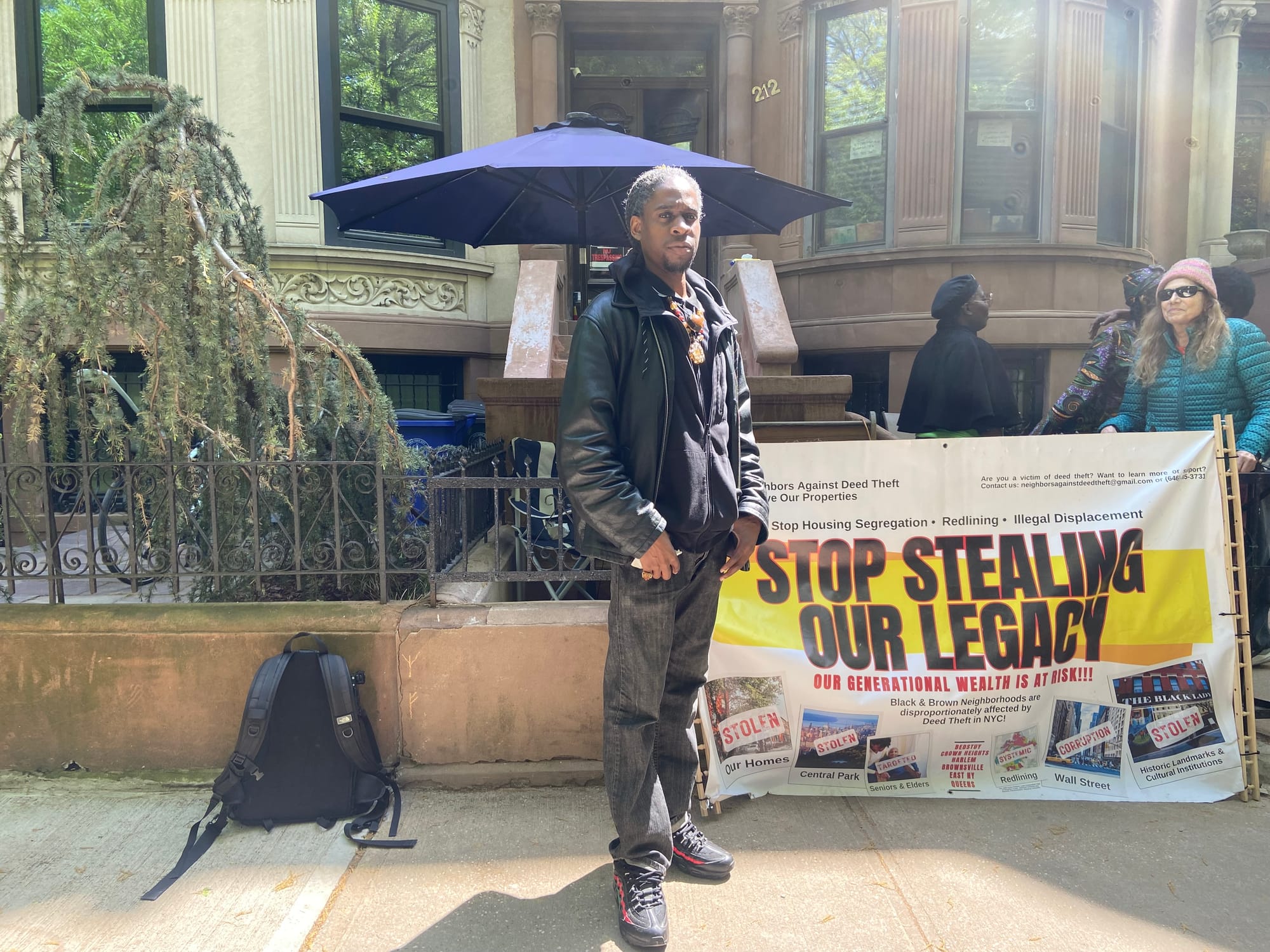
Omar Hardy, 41, a community organizer and coalition leader, said he has been fighting deed theft and related property crimes for over 20 years. He said his family lost both the Slave Theater and the Black Lady Theater, cultural anchors in Brooklyn, through what he described as unlawful seizures.
Advocates with the People’s Coalition to Stop Deed Theft estimate that there are between seven and 10 active deed theft or heir scheme cases on a small stretch of Jefferson Avenue. Prism was unable to independently confirm the number of cases.
234 Jefferson Ave.
Down the street from Charrington’s home, at 234 Jefferson Ave., Ayisha Doyle and her mother Phillipa have been fighting for eight years for Ayisha to stay in a home their family has occupied since 1944. The case began in 2018 after Arlo 67 LLC claimed to have purchased 75% of the property from Phillipa Doyle’s brother, Walter Giles, who had lived in Australia for decades.
In her 1998 will, Phyllis Giles had left her son Walter 75% of the property and Phillipa Doyle 25%. But this will was only filed with Kings County Surrogate’s Court in 2018, more than a decade after their mother died. Arlo’s attorneys alleged that Doyle concealed the will from her brother, leaving him unaware he had any ownership interest. Doyle, who paid off the mortgage on the house in 2016, has not responded to that allegation publicly.
Arlo’s attorneys told Prism that Giles was paid for his interest and signed the transfer documents willingly, and when later interviewed by the New York Attorney General’s Office, Giles confirmed that he had not been defrauded.
But Phillipa and Ayisha Doyle don’t believe there is enough direct evidence from Giles himself, whom they have never seen in court.
“There’s no real physical verification,” Ayisha Doyle told Prism.
“He’s never personally appeared. He’s never said I did this,” she added. “Even if you execute an affidavit, how do I know for sure that this is the person?”
Ayisha Doyle said the situation was especially painful because she maintained the property herself for decades without Giles in the picture.
“He was living abroad for 40 years and just popped in and out for funerals,” she said. “He never contributed anything to the upkeep at his house.”
Ayisha Doyle added that her family continued paying utility bills even after Arlo’s name appeared on the property’s deed.
Arlo turned to the courts to force a sale of the property.
A judge ordered a sale of the house in February 2023, and the home was scheduled for auction. Phillipa Doyle, filing from Trinidad, said in an affidavit that she had never been personally served with the notice of sale and that her daughter and grandchildren were living there. Arlo’s attorneys told Prism that Doyle had been served both at the Jefferson Avenue property and at her home in Trinidad, where she has lived since the 1980s.
In August 2024, the state attorney general’s office intervened, obtaining a temporary restraining order halting the sale while it investigated a deed theft complaint filed by Doyle. But six months later, at a February 2025 hearing, Kings County Supreme Court Justice Robin Sheares vacated the order, finding that the attorney general’s office had misled the court by claiming it couldn’t locate Giles when it had known his whereabouts all along.
According to court records, Sheares said Giles spoke with the attorney general’s office and never told them he had been defrauded.
In a statement to Prism, the attorney general’s office said its investigation remains ongoing and that it has appealed the vacated order, noting that the sale remains stayed while the appeal is pending and that the Doyles are still in their home.
Courts and accountability
For Leroy Clarke, 66, it started with a loan modification. In 2014, he said, he was rushed through a stack of papers at a Queens office by operators of Homeowner Assistance Services of New York, who told him he was signing refinance documents to save his Crown Heights home from foreclosure. Among those papers was a deed transfer, which he said he didn’t know at the time. The single document once signed and recorded with the city, handed ownership of 956 Montgomery St. to Horatio Management LLC. Within months, Clarke alleged in court records, the property was mortgaged for $800,000 and sold to Montgomery Estate Holdings (MEH) for more than $927,000. MEH later said it paid $900,000 and financed the purchase in part with a $300,000 mortgage. Property records show that Clarke had owned the home since 1994.
“They didn’t give me one cent,” he told Prism.
Clarke filed a lawsuit in 2015, alleging fraud, civil conspiracy, and violations of state consumer protection law against a web of LLCs and two attorneys.
In 2015, six individuals were arrested in a multimillion-dollar scam that involved luring vulnerable homeowners through Homeowner Assistance Services and tricking them into selling their homes.
MEH and Horatio representatives did not respond to Prism’s requests for comment. But in court documents responding to Clarke’s lawsuit, MEH argued that Clarke’s claims were “nothing more than a last ditch attempt to claw back title to the Property,” and said there were no allegations of fraud against MEH itself. The company claimed that if fraud occurred, it was allegedly committed by other parties before MEH bought the property, and that it had no notice of Clarke’s claims when it purchased the house from Horatio.
A decade later, Clarke is still fighting to reclaim his house. On April 23, he drove 17 hours from his new home in Sarasota, Florida, to attend a Stop Deed Theft rally after seeing news coverage online. Several people there told him that they had appeared before the same judge as him: Sheares.
Sheares ruled against Clarke in 2024, and he has been in appeals for two years.
As Black residents continue to fight for their homes, some said they feel let down by government leaders and are turning to the community for support.
“There’s a lot of stuff in place, but it’s not being enforced,” Charrington said. “So what’s been helping is people shaming [officials]. The people showing up in our community.”
Hardy, the community organizer, said, “We will not allow anyone to dehumanize us. We will not give up, and we will not give in.”
Editorial Team:
Sahar Fatima, Lead Editor
Lara Witt, Top Editor
Rashmee Kumar, Copy Editor
Arshi Qureshi
Filed Under: