Filed Under:
The map of a future Gaza proposed by Trump’s ‘Board of Peace’ fails Palestinians
The plan does not treat Gaza as a living homeland shaped by generations, but instead treats the Strip as a blank canvas for real estate
Ahmad Abushawish
Real journalists wrote and edited this (not AI). Independent, community-driven journalism survives because you back it. Donate to sustain Prism’s mission and the humans behind it.
As President Donald Trump’s so-called Board of Peace struggles to turn its vision for Gaza’s future into reality, Palestinians are still paying the price. Reuters reported on April 10 that the international body has received less than $1 billion of the $17 billion pledged to the initiative, stalling the broader postwar plan and preventing the U.S.-backed National Committee for the Administration of Gaza from entering the Strip. The board—which has no Palestinian representation but does include Israeli Prime Minister Benjamin Netanyahu, who is wanted for war crimes, as well as leaders from several Arab and other countries—has denied that funding is the problem. But on the ground there is still no clear path toward recovery.
Months after the October ceasefire framework was announced, Gaza remains trapped between political deadlock and the Israeli-imposed siege that has created worsening humanitarian conditions. Violence has continued, with the Gaza Health Ministry reporting that the Israeli military has killed at least 738 Palestinians since the ceasefire began. At the same time, recovery remains heavily constrained, with continued Israeli restrictions affecting the entry of materials and equipment needed for rehabilitation and reconstruction.
Amid such destruction, the Board of Peace’s proposal falls flat. Instead of supporting Gaza toward recovery, the plan promotes a vision that treats the Strip as if it were an empty piece of land, rather than a dense living homeland shaped by generations of linked neighborhoods, history, and social ties.
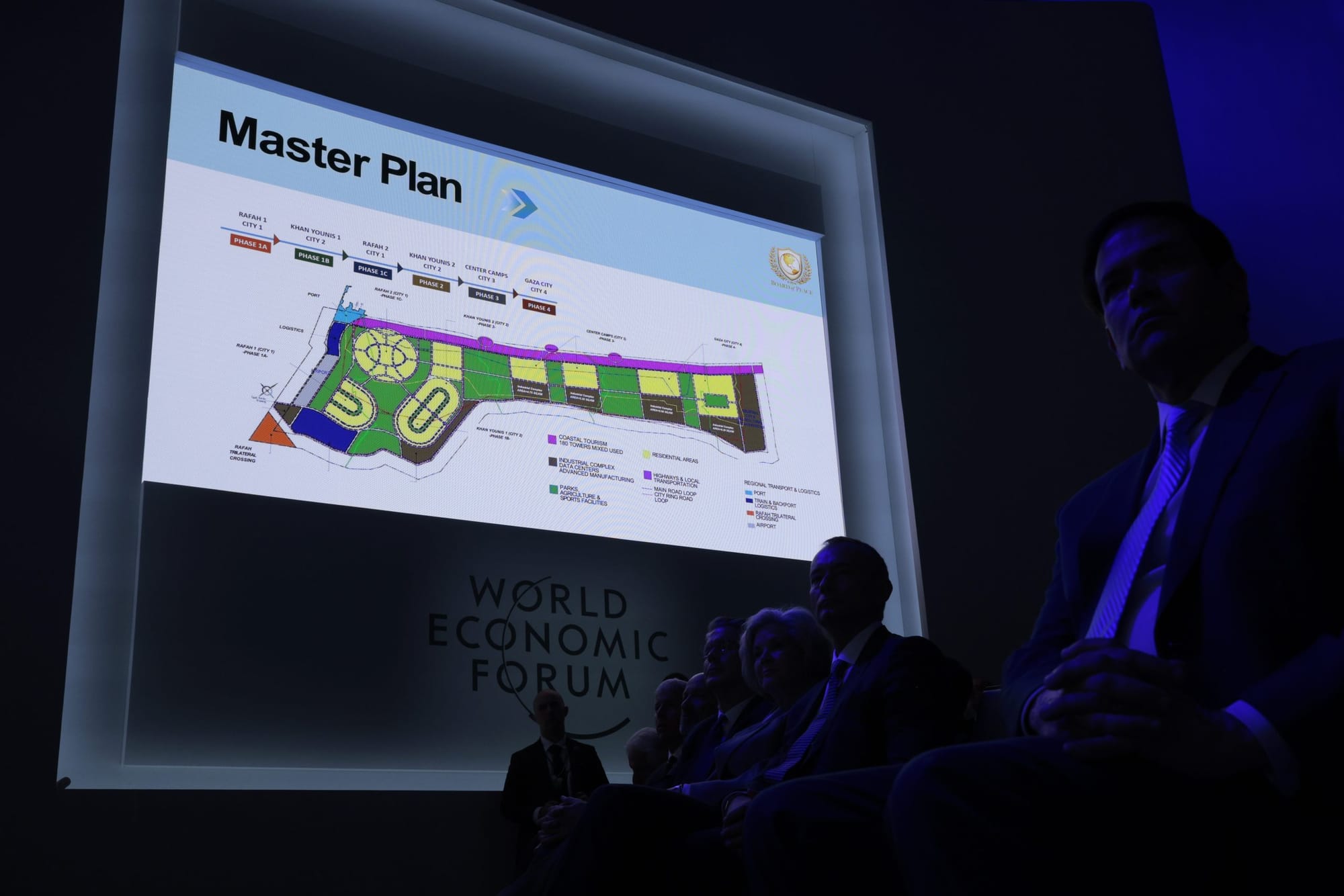
In the glossy renderings of Gaza’s proposed future, the Trump-backed “master plan” for postwar redevelopment unveiled by Trump’s son-in-law Jared Kushner at the World Economic Forum in Davos in January portrays the Strip as a place reborn. Glass towers rising along the sea, industrial zones replacing ruins, parks and sports facilities stretching across the land, and modern housing blocks promising order after devastation.
At first glance, it can seem like an ambitious promise of renewal, a bright future supposedly offered to a people who have endured more than two years of genocide. Yet beneath this language of reconstruction lies a far more unsettling idea. The plan treats the Strip as a blank real estate canvas, ready to be redesigned from above.
Palestinians know better than to take such promises at face value from the U.S., which has armed, funded, and politically shielded Israel’s destruction of Gaza, and now attempts to rebrand itself as a broker of peace. And Israel, the very power that has devastated Gaza and continues to wage genocidal violence against its people, is the last actor that can credibly claim to care about its reconstruction, and yet is somehow involved in the reconstruction plan.
Why should Palestinians trust Trump’s language of peace and prosperity when neither he nor successive U.S. administrations have ever genuinely stood for Palestinian dignity, stability, or self-determination?
Why should Palestinians trust Trump’s language of peace and prosperity when neither he nor successive U.S. administrations have ever genuinely stood for Palestinian dignity, stability, or self-determination?
Rather than offering solutions to the vast ruins left by the Israeli destruction of Gaza, the map seeks to impose a new reality on the ground—one that bears little resemblance to Gaza as Palestinians have known it. More than a reconstruction plan, it is a vision of what Gaza should look like, who gets to imagine it, and which parts of its past are allowed to survive.
The erasure of homes
At a glance, the map turns Gaza into a long, color-coded corridor of functions rather than a living social geography. Residential blocks are arranged in rectangular clusters, broken up by wide green agricultural spaces, bordered in several areas by industrial zones, and tied together by transport corridors, ring roads, and logistics infrastructure. Along the coastline, the plan reserves a continuous strip for tourism and high-rise development, giving the map the appearance of a fully redesigned investment landscape, rather than a place shaped by existing neighborhoods, camps, and communities.
Under the proposed map, entire neighborhoods are assigned new functions. Most of Jabalia camp and all of Maghazi camp—which were originally established in 1948 and 1949 as the result of the Nakba—are turned into parks, agricultural land, and sports facilities, while Beit Hanoun, most of Beit Lahia, Gaza’s Old City, and large parts of Shujayea and Zeitoun are absorbed into industrial and data center zones.
In doing so, the plan treats Palestinian homes as if they were merely disposable properties, easy to erase and replace. But these homes—whether completely destroyed or only partially damaged—hold layered histories. Many were built over years of sacrifice, as families in Gaza saved coin by coin from the sweat of their labor, laying stone upon stone to build a home of their own. Under the suffocating Israeli siege imposed on Gaza since 2007, building a family house has come to feel less like a normal milestone and more like a distant dream for many Gazans. Yet this map callously aims to replace those homes with small apartments in anonymous buildings.
“What hurts most about losing my home is losing all the moments of moving from one stage of life to another,” said Menna Qudaih, 21, who was based in Khan Younis before the so-called yellow line engulfed her family home. The demarcation line marks where Israeli forces withdrew under the first phase of ceasefire in October. It covers almost 58% of Gaza territory.
“Every corner of that house had witnessed something: long nights of studying, the joy of success, and all the plans I made for the future. It was the place where I built my achievements, and in losing it, I felt I had lost those achievements too,” Qudaih told Prism.
“The moment I left, I lost my private world, the space where I had control over my surroundings, where I could move freely with a sense of privacy that gave me the ability to think and create,” Qudaih said. “Now I feel I am living in something temporary, a place without that space or psychological calm. My relationship with my home was so intimate that I knew where everything was, even in the dark.”
When I asked whether she would agree to give up her right to her ruined home in exchange for an apartment in a residential building, she said that no apartment could ever compensate for the home she lost.
Infrastructure concerns
The map also appears unworkable on the ground for practical engineering reasons. Gaza is a dense environment with limited land, intertwined neighborhoods, overburdened infrastructure, and essential service networks that cannot simply be moved or redrawn on paper. Any proposal that focuses on visual order while ignoring the realities of land use and urban density is likely to fail at the level of implementation.
“The plan only partially and concisely reflects reality,” said Nabil Al Salhi, head of Nuseirat Municipality. “The Gaza Strip suffers from a very high population density within a limited area, and this places great pressure on services and infrastructure. People’s needs are not limited to providing new housing, but include continued access to water, sanitation, electricity, education, and work.”
The map treats Gaza as a geometric space, when in reality it is a living fabric.
Nabil Al Salhi, head of Nuseirat Municipality
“The map treats Gaza as a geometric space, when in reality it is a living fabric. On paper, roads and buildings can be easily redistributed, but on the ground we are faced with overlapping properties, camps with historical specificity, and interconnected infrastructure with limited capacity,” Al Salhi said. “Focusing on urban form without addressing these aspects makes the plan far from meeting the actual needs of the population.”
I asked Al Salhi what he believed was the most logical and fair alternative to rebuild Gaza.
“The most realistic and just approach to reconstruction is one that starts from the existing reality, not from outside visions,” he said. “It should focus on keeping people in place as much as possible, while gradually improving infrastructure, services, and urban conditions.”
He said that Gaza needs better infrastructure, more efficient land use, and organized urban expansion without uprooting communities.
“Any reconstruction process must involve residents, respect the character of each area, and ensure a fair distribution of services,” Al Salhi added. He stressed that any approach that ignores these elements will remain theoretical, no matter how advanced it appears in design.
As Palestinians, we do want to move forward and rebuild our future—a future that was shattered by the same powers now pretending to care about us.
In the end, Gaza is not an empty space that can simply be redrawn, but a living, complex society. Any plan that ignores this reality is doomed to fail, no matter how coherent it may appear on paper.
Editorial Team:
Sahar Fatima, Lead Editor
Lara Witt, Top Editor
Rashmee Kumar, Copy Editor
Ahmad Abushawish
Filed Under: