Filed Under:
Health care workers in Lebanon face Israel’s illegal attacks
Health care and humanitarian workers warn that the attacks put a strain on Lebanon’s medical infrastructure, similar to how Israel targets Gaza’s health care system
Real journalists wrote and edited this (not AI). Independent, community-driven journalism survives because you back it. Donate to sustain Prism’s mission and the humans behind it.
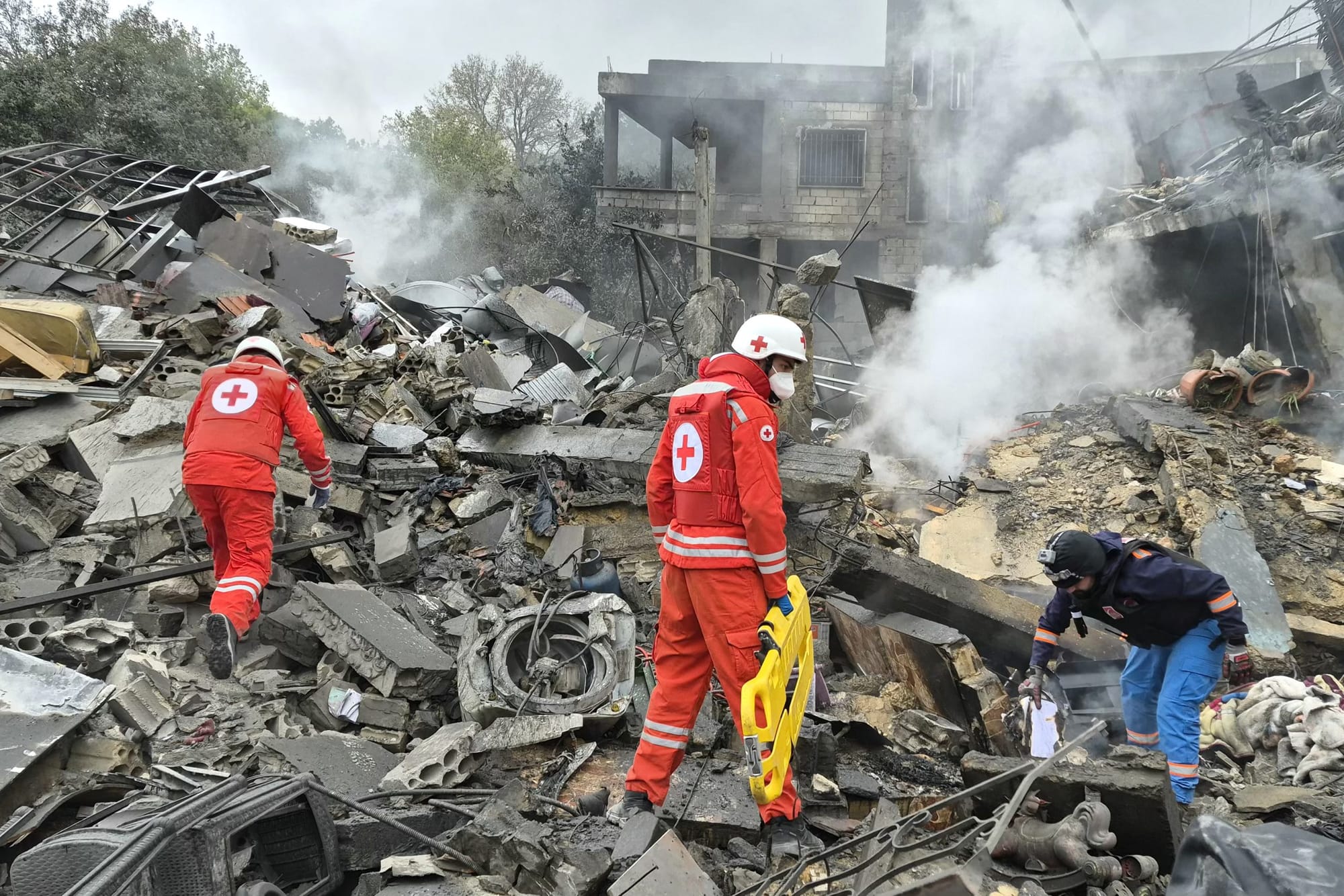
Israeli strikes on southern Lebanon and Beirut killed more than a dozen people on April 5, as Israel threatened to destroy bridges connecting Lebanon to other parts of the country and Syria. Israel’s illegal invasion and ground siege continues with deliberate attacks on residential areas, specifically Shia communities, schools used as shelters, hospitals, and journalists, displacing more than 1.2 million people and killing about 1,500.
Medical and humanitarian workers warn that the attacks put a strain on Lebanon’s medical infrastructure, similar to how Israel targets Gaza’s health care system.
In October 2024, Israel began a ground invasion in the south of Lebanon after injuring 2,700 Lebanese nationals a month prior by placing explosives inside pagers it claimed belonged to Hezbollah members. A ceasefire was then initiated in November 2024, which Israel violated more than 10,000 times before escalating bombardment on March 2 of this year.
Dr. Tania Baban, Lebanon director at MedGlobal, spoke to Prism about her experiences working with the international humanitarian organization during times of conflict ever since the Beirut Port explosion in 2020.
“ We’re still here, running this emergency response now in 2026, less than two years after the escalation in 2024,” Baban said.
Baban said the evacuation orders Israel issued in Lebanon were similarly as unclear and chaotic as those issued in Gaza. Some people have even received fake evacuation orders from spoofed phone numbers, including Baban and her elderly parents, causing them to evacuate their home in Beirut 10 days before her conversation with Prism.
“ The difference this year in this escalation is that there seems to be a stronger aggression, with an illegal occupation of the southern lands, in addition to the fact that there have been aggressive attacks on the health care system, on ambulances, on health care workers,” Baban said. “It almost feels like what they were doing in Gaza was just to test the waters for the world to see if anybody was gonna stop them. And, lo and behold, nothing was done other than condemning this and condemning that, and thoughts and prayers, and things are happening again in Lebanon.”
Baban said she feels privileged to still have the ability to leave her house, unlike those facing Israel’s widespread attacks in Gaza. But she refuses to leave the country, as she feels a responsibility to MedGlobal and to the people of Lebanon to deliver aid.
“ There’s a sense of orchestration [with the Lebanese Ministry of Health], but at the same time, there’s so much chaos on the ground because of the staggering numbers of displaced people and the rapidity in which it’s happening on a daily basis,” Baban said.
According to Baban, in the first few weeks of March, over 500,000 residents fled at once, leaving people stuck in traffic for 22 to 24 hours. Pregnant women were forced to give birth on the side of the road and over 55 clinics were shut down or attacked.
Baban also said most of the casualties have been children, as the bombs end up killing them rather than injuring them.
Dr. Sam Sheikali, a Lebanese American emergency medicine physician in Chicago, spoke to Prism about his upcoming medical mission to Lebanon, where he also served in October and November 2024, during Israel’s previous aggression.
“ I was in Lebanon in 2006 as a teenager during the July war of 2006, and that was actually a big inspiration for me to even go into medicine, and I was trying to figure out which specialty I felt I could have the greatest impact, particularly in times of war and conflict,” Sheikali said.
After the 2024 pager attack, Sheikali made it to a hospital in south Lebanon where he said the medical mission team focused on providing equipment and training for mass casualty incidents.
One of Sheikali’s concerns during his previous mission was not about whether there would be health care workers to treat the large volume of patients coming into the ER with injuries, but that patients could not afford to get the care they needed.
“ Being an ER doc in the U.S., we’re kind of expected to order a lot of stuff like CT scans, all the blood work, without thinking a whole lot about it,” Sheikali said. “Initially, I was like, okay, these are the things I need, and the nurse pulled me to the side and was like, Sam, people can’t afford to do this stuff. The benefit, I guess, of us being there was that we were there for free and the supplies that we provided were also free to the patients, so we would try to utilize our stuff to make it so that they would get the care that they needed.”
One key item for Sheikali’s upcoming mission, which he also brought during his last mission, are combat tourniquets, which can stop bleeding in most cases.
“ I was actually surprised that most of the hospitals don’t have them,” Sheikali said. “A lot of people end up hemorrhaging and dying quickly in the emergency department or en route.”
Sheikali also said that running out of blood is common for both big and small hospitals, so medical workers try to establish a “walking blood bank,” where teams can provide donations at any time.
As Israel’s Prime Minister Benjamin Netanyahu vows to expand Israel’s illegal occupation of Lebanon, Baban said medical and humanitarian teams on the ground are preparing for these attacks by Israel to be long-term, as opposed to the aggression in 2024.
“You start thinking, how can I plan my project long-term to support the ministry, to support the displaced people, to be able to carry also the organization and continue this work while you’re thinking of yourself and your loved ones in your home,” Baban said. “I’m a trained doctor and I’m a trained surgeon, so there’s this kind of autopilot that takes over.”
Baban said some people at MedGlobal have also expressed worry that staff might burn out during Israel’s repeated attacks.
“I told them it’s not during the escalation that I burned out last time,” she said. “But once the ceasefire hit in 2024, it was after that that you feel like you’ve completely blanked out because that’s when you process.”
Editorial Team:
Sahar Fatima, Lead Editor
Lara Witt, Top Editor
Rikki Li, Copy Editor
Neha Madhira
Filed Under: