Filed Under:
Illinois commission could play a role in holding ICE accountable, Chicago organizers say
The Illinois Accountability Commission’s documentation of violent federal immigration enforcement actions in Chicagoland could be helpful in the future, even if immediate results are unlikely, activists say

Noah Berlatsky
Real journalists wrote and edited this (not AI). Independent, community-driven journalism survives because you back it. Donate to sustain Prism’s mission and the humans behind it.
As Chicagoland communities await a state commission’s final report on violent federal immigration enforcement actions, some activists are thinking through how the evidence could be used to hold federal agents accountable.
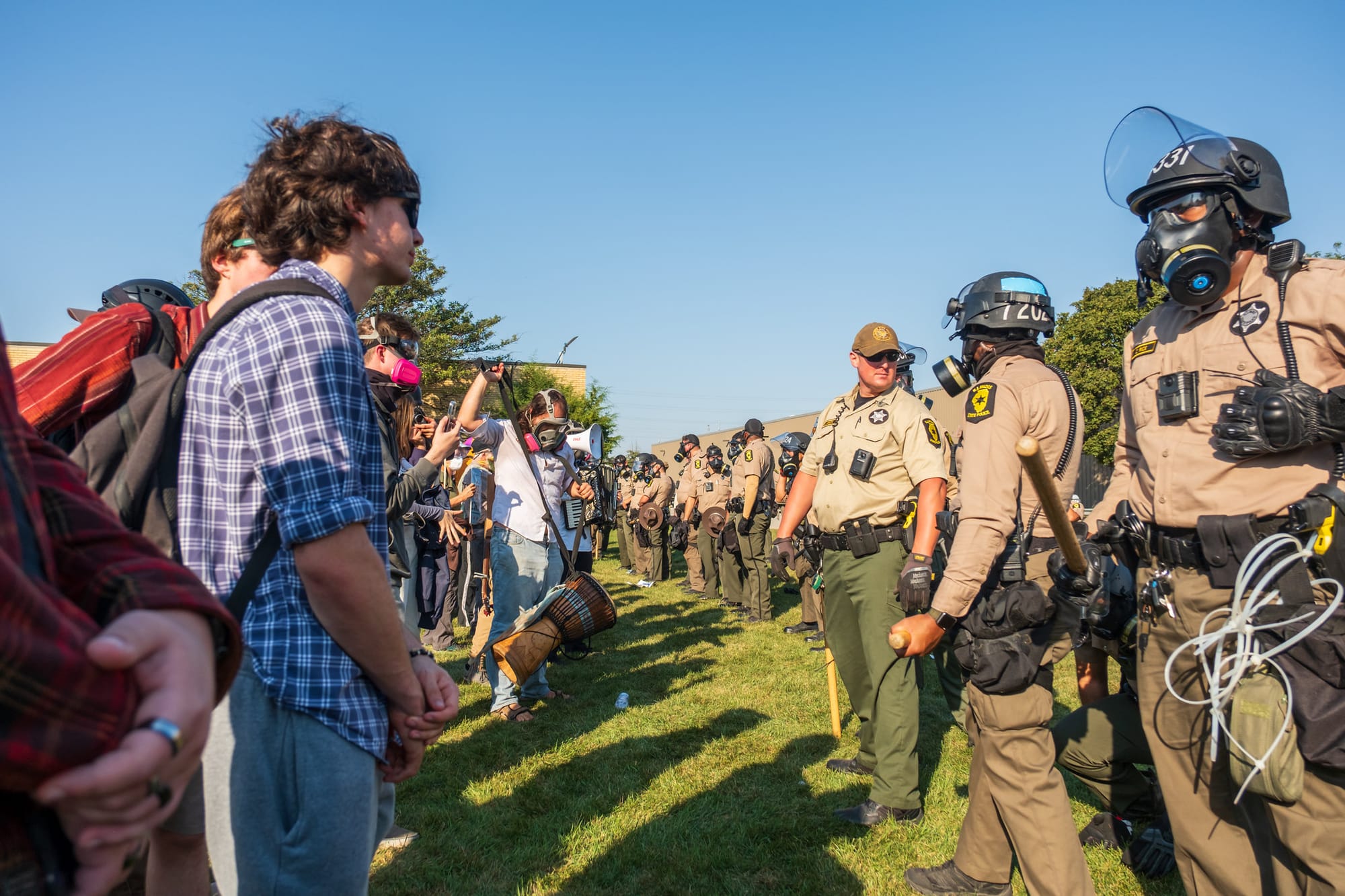
In September, the Trump administration targeted Chicagoland for immigration enforcement Operation Midway Blitz, using militarized tactics that terrorized communities throughout the city for months. In October, during the height of the chaos caused by federal agents, Illinois Gov. J.B. Pritzker issued an executive order establishing the Illinois Accountability Commission (IAC).
The IAC’s final report is scheduled to be released on April 30; an interim report was filed in January. The interim report has given experts and community activists a chance to evaluate and respond to the commission’s work and recommendations and to think about what more the state could do to resist federal violence against its people.
Midway Blitz shut down whole neighborhoods as people were afraid to leave their homes to work, shop, or take their children to school. Months after the surge was drawn down in November, many people and communities continue to live in fear of the remaining Immigration and Customs Enforcement (ICE) agents who are still patrolling and targeting the city. The government has since suggested it may ramp up enforcement again in the spring.
The IAC’s independent board was “tasked with capturing and creating a public record of the conduct of federal law enforcement agents and recommending actions to hold the federal government accountable.” Its interim report explains that the commission is gathering publicly available information about federal actions, as well as interviewing eyewitnesses who observed misconduct and use of excessive force by federal agents. It has created a portal for the community to report on and upload documentation of their experiences. It has also held a number of public hearings with community members and experts.
The interim report created an extensive timeline of Midway Blitz’s activities and issued a number of preliminary recommendations. These included more standards and training for federal agents in use of force, the banning of face masks, limitations on surveillance technology, and demands for more transparency about federal actions and disciplinary procedures. Finally, the commission is examining possible ways in which Illinois can prosecute or otherwise hold federal agents accountable, for example, by barring former ICE agents from law enforcement jobs in Illinois, in line with a current bill before the General Assembly.
Garrett Graff, a journalist who has spent more than 20 years researching the evolution and abuses of ICE and Customs and Border Protection (CBP), testified before the commission in January. He explained to Prism that he felt the commission and its work was important. “The launch of Operation Midway Blitz is one of the most disturbing chapters that we have ever seen in American history,” he told Prism. “It is the arrival on America’s streets of something that we would recognize very clearly if it was happening in a foreign country, and would be very quick to label it, as I said in my testimony, as the arrival and deployment of a right wing paramilitary militia loyal to the regime that is staging a terror campaign against separatist regions led by key political figures of the opposition.”
Graff said that because of American exceptionalism, however, the media and many commenters have not really been willing or able to grapple with the extent of the danger. The IAC, he said, “is a real opportunity to document what this chapter has actually looked like on the ground in ways that will be historically important, even if it never leads to criminal prosecutions.”
Graff also told Prism that while he believed that policy recommendations about masking and use of force could be helpful in reducing abuses, the reforms fail to address the only two things that he said really matter: culture and leadership.
“These are fundamentally broken organizations led by people who are sending all of the wrong messages,” Graff said.
Journalist Andrea Pitzer, author of “One Long Night: A Global History of Concentration Camps,” echoed both Graff’s hopes and reservations. “Documenting events and creating a timeline in close proximity to when abuses occurred, particularly when they take place on a large scale,” she told Prism by email, “is often a gift to the victims, to history, and to humanity.”
At the same time, however, she said that there were some areas where she believes the commission could have gone further, or been clearer, in identifying abuses. For instance, the commission notes that immigration detention, often of people who have not committed crimes, is “in many cases worse than criminal incarceration.”
That is important, Pitzer says, but she would have liked the commission to acknowledge the ways in which ICE detention centers “echo prior concentration camp systems” in order to emphasize “the potentially much larger dangers that could arise if we don’t put a hard stop to these abuses.”
“It was good that [the IAC] at least noted that our democracy is in danger in the policy recommendations,” Pitzer told Prism. “Yet I wish they would have said that they would be exploring whether real change will actually be possible without a fundamental dismantling of the Department of Homeland Security, CBP, and ICE. My sense is that it’s important not to limit their scope of review too much this early in the process.”
She said that the report would be strengthened by even a line or two that noted that there are long-term issues with carceral and immigration policies that predate Donald Trump’s presidencies and may have contributed to what is happening now.
“These kinds of operations, and this kind of detention, don’t arise in a vacuum,” she said.
Chicago community organizers and activists have also seen the IAC as being potentially helpful in their resistance to ICE. Pastor Matt DeMateo, CEO of New Life Centers in Chicago’s Little Village, has long been working with immigrant communities. His organization especially ramped up its efforts to help thousands of immigrants bused to Chicago by Gov. Greg Abbott of Texas from 2022 to 2024.
DeMateo testified to the IAC in December about an incident last year in which he saw CBP agents deploy flash bangs and gas unilaterally, with no threat in sight. He also witnessed the aftermath of an incident in which a CBP agent pepper-sprayed a family on a shopping trip to Sam’s Club, including a 16-year-old and a 1-year-old child.
The family had video of the incident, and DeMateo uploaded it on social media. The frightening images went viral.
“Within 48 hours on DHS website,” DeMateo told Prism, “my video was on there as ‘Stamped-false! ICE does not pepper spray babies.’”
These “blatant lies,” DeMateo said, convinced him of the importance of the public record. “Part of our work now is truth telling—what’s happening to these families, documenting it, posting it, getting it out there.”
Testifying to the commission, he said, was a way to put evidence on the record and have a written log of violent federal immigration enforcement activities. That’s vital for accountability and justice, he said, because, in the absence of truth-telling, “due process is all but gone.”
Nicholas Richard-Thompson, deputy chief of staff of the Mayor of Aurora and co-founder of Kalpulli, an immigrant aid organization, has worked with the governor’s office on issues involving ICE and has also worked with rapid response to ICE and CBP.
Like DeMateo, Richard-Thompson told Prism that the IAC was important in sending a message to the federal government that there will be accountability for immigration enforcement agents.
While the work is necessary, he said, it “does nothing right now,” leaving many residents skeptical.
“I understand where people are coming from; generally anything the state is doing seems to come off as cosmetic,” Richard-Thompson said.
Still, he said, there’s a role for IAC to play alongside community tactics such as rapid response observers, legislative advocacy, mutual aid, and union organizing.
“I think it gives a great legitimacy when you see a local municipal body or village working with a grassroots organization and both of them submitting documentation of ICE abuses towards the commission,” Richard-Thompson said. “I think that does hold more weight.”
The federal government has a great deal of power, and building resistance to that power is a difficult and complicated task. Analysts and organizers believe the IAC can help a bit in the short term, and perhaps more if Republican electoral power wanes. In the meantime, DeMateo said of federal agents, “I pray they don’t come back. I plan that they will.” For many activists, the IAC is one part of that plan.
Editorial Team:
Sahar Fatima, Lead Editor
Lara Witt, Top Editor
Stephanie Harris, Copy Editor
Noah Berlatsky
Filed Under: