Filed Under:
Israel’s ‘Orange Line’ threatens to squeeze Palestinians into 30% of Gaza
The Israeli military has creeped beyond the “Yellow Line” established during ceasefire talks, leaving Palestinians with few safe places to go
Ahmad Abushawish
Real journalists wrote and edited this (not AI). Independent, community-driven journalism survives because you back it. Donate to sustain Prism’s mission and the humans behind it.
More than 2 million Palestinians are being systematically trapped within an increasingly narrow, unlivable corridor of the Gaza Strip. What began as the militarily enforced “Yellow Line” has now expanded into an aggressive new Israeli-controlled perimeter known as the “Orange Line,” a shifting boundary forged by months of Israeli military excavations, land leveling, and the constant relocation of concrete markers.
Speaking to an audience at a conference in an occupied West Bank settlement, Israeli Prime Minister Benjamin Netanyahu openly outlined his administration’s territorial targets for Gaza.
“We now control 60% of the territory in the Strip. You know, we were at 50, we moved to 60. My directive is to move to 70%. Let’s start with that,” Netanyahu said, as the crowd yelled, “100!”
This creeping territorial expansion threatens to leave Palestinians isolated and hypercongested in just 30% of Gaza’s total territory. Even before the genocide, the approximately 140-square-mile enclave was recognized as one of the most densely populated regions on earth.
The physical consequences of the advancing Orange Line on the daily lives of Gazans are immediate and disastrous. As the Israeli military pushes families further west to avoid live fire from soldiers at the boundary, it creates waves of displacement, particularly squeezing people out of Khan Younis, eastern Gaza City, and parts of the north.
“We are exposed to intensive waves of bullets and shells daily,” said Nedaa Abu Rjela, a 26-year-old displaced Palestinian who lives in a makeshift tent near the Al-Shakoush area, a territory located between Rafah and Khan Younis. “Those random bullets are constantly shot over our heads. Just recently, a stray round severely injured a 7-year-old child living in the tent right next to mine.”
Abu Rjela’s camp is directly adjacent to the original Yellow Line, the perimeter that swallowed her family home in Abasan Al-Kabira, eastern Khan Younis, months earlier.
Abu Rjela said that she and her family cannot simply pack up and move further west toward the coast to escape the live fire because the remaining “safe zones” designated by the Israeli military are an illusion.
“We have searched relentlessly for a safer place further west, but we couldn’t find anything,” she said. “All the remaining available spaces deeper inside the designated zones are either completely overpriced and impossible to rent, or they sit directly on top of local garbage dumps and raw sewage overflows.”
Danger in the north
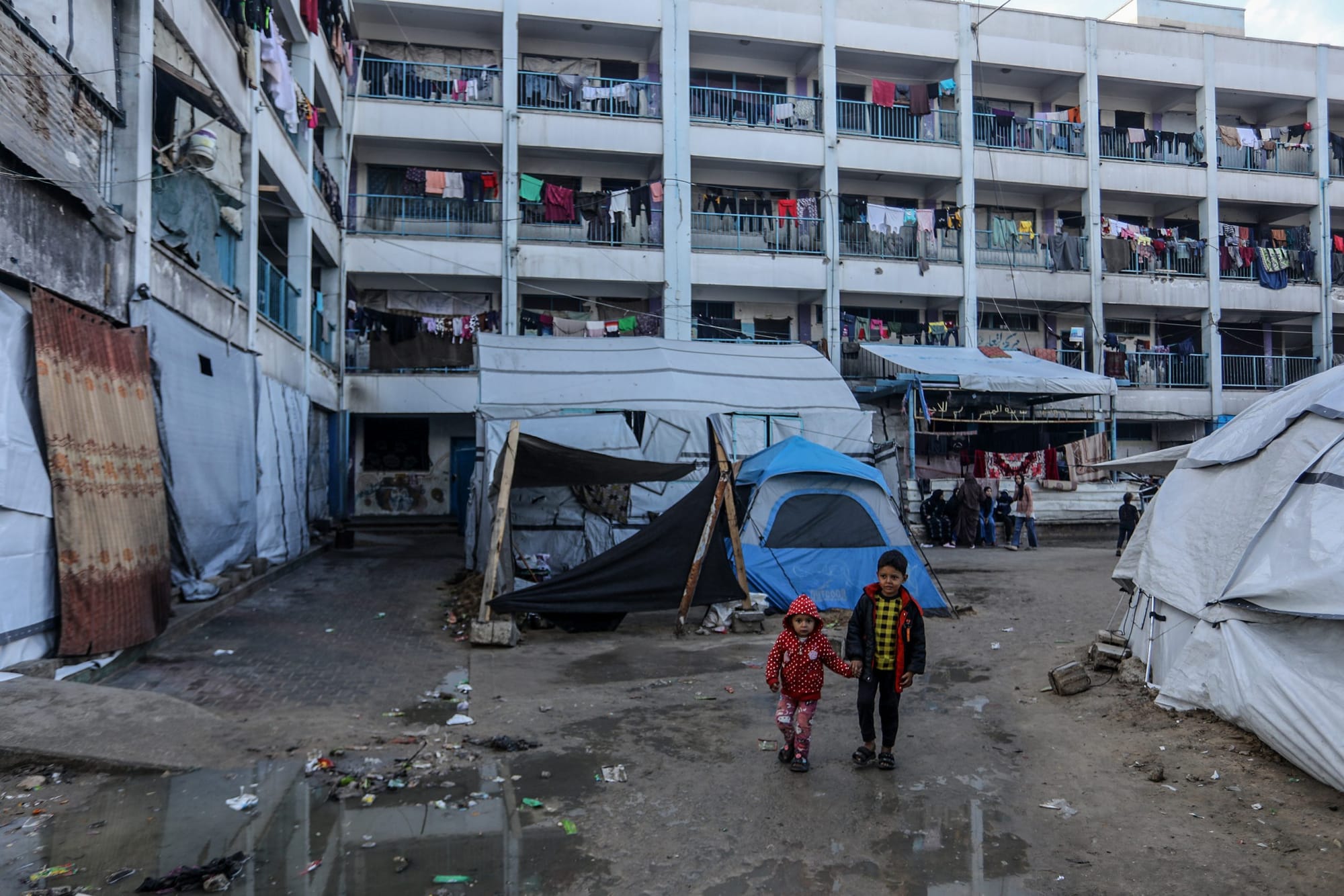
While the squeeze intensifies in the south, an identical nightmare is unfolding in northern Gaza. In the ruins of the Jabalia refugee camp, near Kamal Adwan Hospital, thousands of families remain trapped against the northern perimeters. Among them is Khadija Saleh, who lives with her mother, sisters, nieces, and nephews in a classroom shelter at the Abu Hussein School, a building sitting directly on the edge of the military’s advancing line.
“Life here is very hard because we are so close to the line,” Saleh said. “Bullets literally strike the walls of our classroom. I live on the third floor of the school, and from there I am completely exposed.”
With the surrounding neighborhood completely erased, the school has become a direct target for the Israeli soldiers. “There is no cover left between us and the Israeli forces,” Saleh said.
“Whenever random gunfire breaks out, everyone inside the classroom freezes in place,” she said. “Several people living near the line have been killed, including children. One child was shot in the head while simply standing inside a classroom.”
The Associated Press recently published interviews with anonymous Israeli soldiers who said they were given orders to open fire on anyone approaching the Yellow Line in Gaza. The soldiers confirmed that some targeting operations were carried out based on guesswork, while one of them said, “To call it a ceasefire is a joke.”
Saleh also told Prism about other Israeli attacks, including one night on April 26 when she said quadcopters—a type of drone—began dropping grenades onto the roof of the school. Living on the third floor, Saleh and her family were very close to where the grenades fell.
“The attacks became so intense that we had no choice but to flee in the middle of darkness,” she said. “There was only my mother, my sisters, and the children. We walked through the streets in total darkness, convinced we might be killed at any moment, while the quadcopters followed right above our heads.”
People often ask why we stay so close to such a dangerous area. The answer is simple: We have nowhere else to go.
Khadija Saleh, Palestinian living in Northern Gaza
“People often ask why we stay so close to such a dangerous area. The answer is simple: We have nowhere else to go,” Saleh said.
“Even now, as I am speaking, they are expanding the area,” she said. “Tanks advance toward the zone separating us from the line. We can see the soldiers with our own eyes walking in front of us. The area becomes more dangerous every day, yet we are still forced to remain. If we leave this area, we will literally be left to sleep in the street.”
Vertical limits
This massive influx of displaced people is being forced into a landscape that has lost its ability to hold them. Historically, Gaza managed its extreme population density by growing vertically, relying on high-rise residential towers and multistory apartment buildings to house families. Today, with over 90% of homes and entire blocks erased or reduced to unstable rubble, vertical living is impossible.
As a result, the people of Gaza are packed into suffocating, endless grids of makeshift tents that offer no protection from the intense heat of Gaza’s summer. Because these camps must expand outward rather than upward, they are rapidly consuming what little remains of Gaza’s open spaces, completely eliminating agricultural land already ravaged by bombing and basic breathing room. Families are left to survive in a chaotic, hyperdense expanse where privacy, sanitation, and physical safety simply do not exist.
A deadly buffer zone
The Yellow Line was established during ceasefire negotiations as a temporary, strictly monitored demarcation line meant to separate military forces and allow a buffer. However, the Israeli military has spent months quietly redefining these boundaries.
The newly emerging boundary, marked in orange on Israeli maps, is not a legal border, but a creeping, unilaterally enforced perimeter that pushes deeper into Palestinian territory.
Meanwhile, political efforts to transition into a permanent peace have completely stalled as Israel continues bombing and killing Palestinians in Gaza. High-level talks in Cairo under U.S. mediation have made almost no progress. Israel continues to insist on the total disarmament of Hamas before moving forward, while Palestinian groups maintain that previously agreed-upon humanitarian and withdrawal terms must be fully implemented first.
Between the start of the ceasefire on Oct. 10 and Feb. 27, the United Nations documented the killing of at least 224 Palestinians, including children, who were shot east of or near the original Yellow Line, often under military claims that they were approaching or trying to cross the boundary.
On Dec. 17, the Israeli military’s chief of staff was caught on a recorded audio briefing to soldiers on the ground, explicitly stating, “The Yellow Line is the new border.” This statement directly violates the core tenets of the signed ceasefire agreement, under which the line was strictly defined as a temporary, nonpermanent military withdrawal boundary. By declaring it a permanent border, Israeli military leadership appeared to reveal the true intent behind the ongoing excavations, land clearing, and fatal sniper fire: to permanently slice away chunks of Gaza, ensuring that the families displaced from these zones can never return home.
The creeping boundary lines in Gaza are not an isolated phenomenon, but rather part of a broader, systemic policy of territorial confiscation targeting Israel’s neighbors. Since Oct. 7, Israeli military forces have physically advanced onto the lands of three of its neighbors—Lebanon, Syria, and Palestine—fundamentally altering the geography of the region through unilateral force.
Several Israeli leaders openly talk about establishing “Greater Israel,” which would stretch Israel across the Middle East, running from the Nile River in Egypt to the Euphrates River in Iraq.
The rhetoric, combined with the shifting lines in Gaza, the military zones in southern Lebanon, and Israel’s takeover of at least 135 square miles of Syria after the fall of its government, has alarmed many within and outside the region as hallmarks of a military threatening the independence of neighboring countries and crushing the lives of millions of people.
Editorial Team:
Sahar Fatima, Lead Editor
Lara Witt, Top Editor
Stephanie Harris, Copy Editor
Ahmad Abushawish
Filed Under: