Latest legal fight over admissions at top Boston public schools garners pushback from multiracial coalition
Multiple racial justice groups are attempting to fight a second lawsuit brought by a group of white and Asian parents alleging racial discrimination over changes to Boston “exam schools” admissions that seek to increase diversity
Eliza Dewey
Real journalists wrote and edited this (not AI). Independent, community-driven journalism survives because you back it. Donate to sustain Prism’s mission and the humans behind it.
More than a year after the Supreme Court declined to hear a case from a group of white and Asian parents alleging racial discrimination in a Boston Public Schools policy, another lawsuit by the group is coming up on an important court date.
It’s just the latest chapter in the yearslong fight over admissions to Boston’s top three public schools, known locally as “the exam schools.”
The newer lawsuit, filed in July by the Boston Parent Coalition for Academic Excellence after the Supreme Court declined in December 2024 to take up a similar suit by the group, has garnered pushback from a coalition of organizations.
“What’s at the heart of this case is a school district taking some steps to make its selective high schools more fairly available to all students in the city,” said Allison Scharfstein of the NAACP Legal Defense Fund, one of the groups in the coalition.
“A desire for racial diversity in schools is entirely lawful,” she added. “What schools can’t do is treat students differently on the basis of race. And this [admissions] policy absolutely does not do that.”
The case centers on an overhaul of the exam schools admissions process that places more emphasis on student grades and neighborhoods, which advocates say boosts racial and socioeconomic diversity within Boston’s top public high schools.
“This policy takes into account students’ socioeconomic status, which is actually something that education experts recommend as a best practice, because we know that wealth and access to resources are highly correlated with test scores,” Scharfstein said.
The NAACP Legal Defense Fund, the Asian American Legal Defense and Education Fund, LatinoJusticePRLDEF, and Asian Americans Advancing Justice-AAJC filed motions in November on behalf of two community organizations in Massachusetts that represent Black, Latinx, and Asian families in Boston: Boston Education Justice Alliance (BEJA) and the Asian Pacific Islanders Civic Action Network.
A hearing on those motions—one to intervene and one for the case to be dismissed—is coming up on March 10.
The group behind the lawsuit said its case was strengthened by Students for Fair Admissions v. Harvard, the 2023 Supreme Court ruling that struck down Harvard University’s race-conscious admissions policy.
“This lawsuit is important to vindicate the right of all students to be treated equally in the Exam School application process,” Christopher Kieser, lead attorney with the Pacific Legal Foundation, told Prism via email. “The use of proxies for race as a way to avoid strict judicial scrutiny into racial preferences will only proliferate after Students for Fair Admissions, and this case seeks to establish that intentional discrimination is still unconstitutional even when done through proxies.”
A yearslong fight over access
The 2025 lawsuit is just the latest salvo in a yearslong and often bitter fight over who gets to attend the city’s three top public schools: Boston Latin School, Boston Latin Academy, and the John D. O’Bryant School of Mathematics and Science. It’s a fight that gets to the heart of educational equity in a city where the public schools “remain intensely segregated and the academic outcomes of the students they serve are staggeringly unequal,” as The Boston Globe reported in 2024.
To put it another way: Of the 2,500 white students enrolled in Boston Public Schools in 2020, a whopping 72% were enrolled in one of the three exam schools, as reported in 2020 by WBUR.
The latest battle started when the city made changes to its exam school admission policies in October 2020 in response to the COVID-19 pandemic, with the school committee unanimously approving a plan to drop the admissions test for one year. A temporary plan was put in place that admitted students based on their scores on a 2019 state standardized test, their grades, and their ZIP codes.
More specifically, the plan allocated 20% of seats to students citywide with the top grades. The remaining 80% of seats were distributed based on grades and ZIP codes, with the first pick in each round going to students in low-income areas.
The working group behind the plan estimated that it would increase the share of Black and Latinx students invited to join the three exam schools by 10 percentage points. The president of the Boston NAACP chapter at the time told the school committee that its passage of the plan would “undoubtedly be a defining moment in our city.”
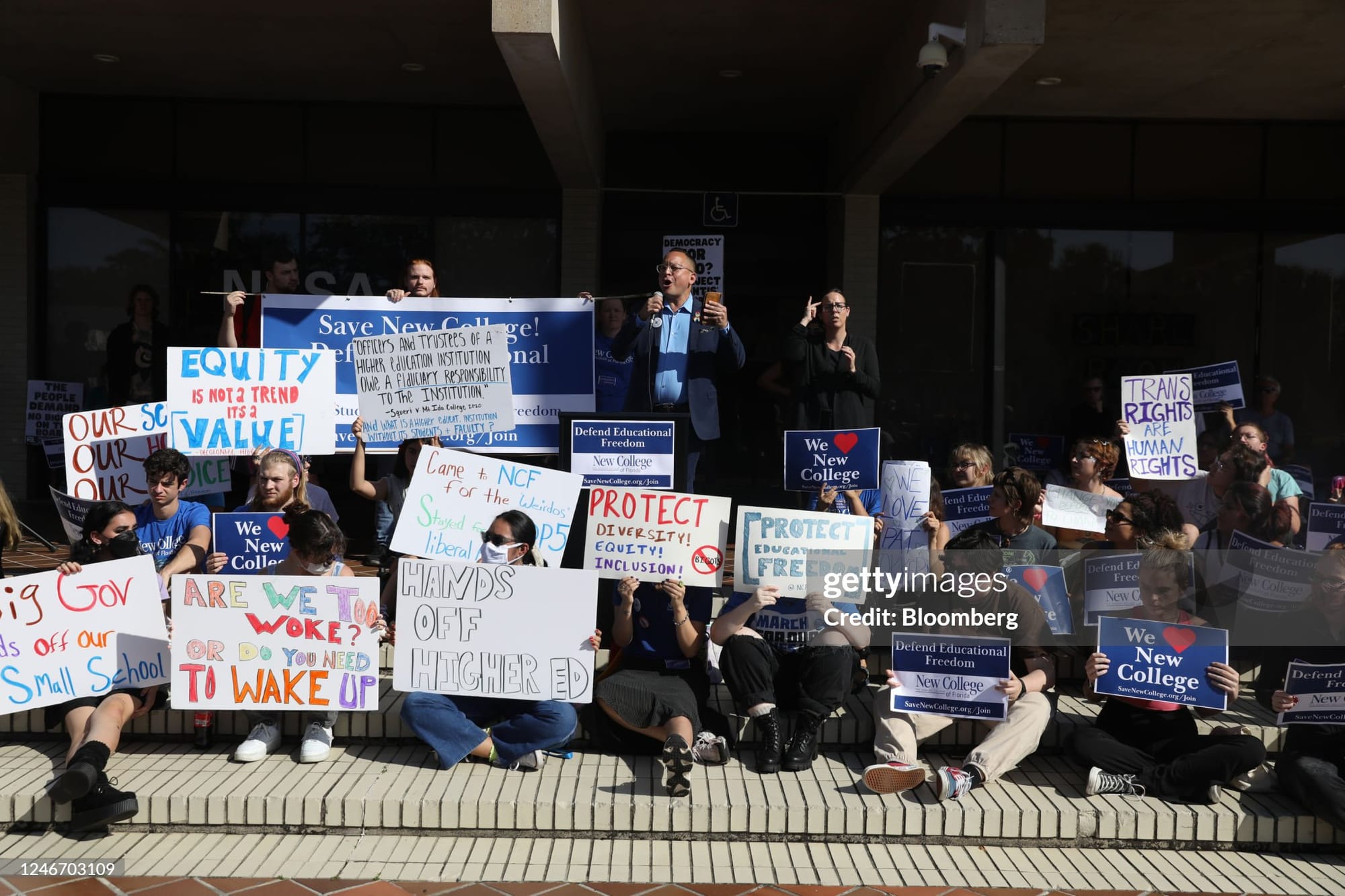
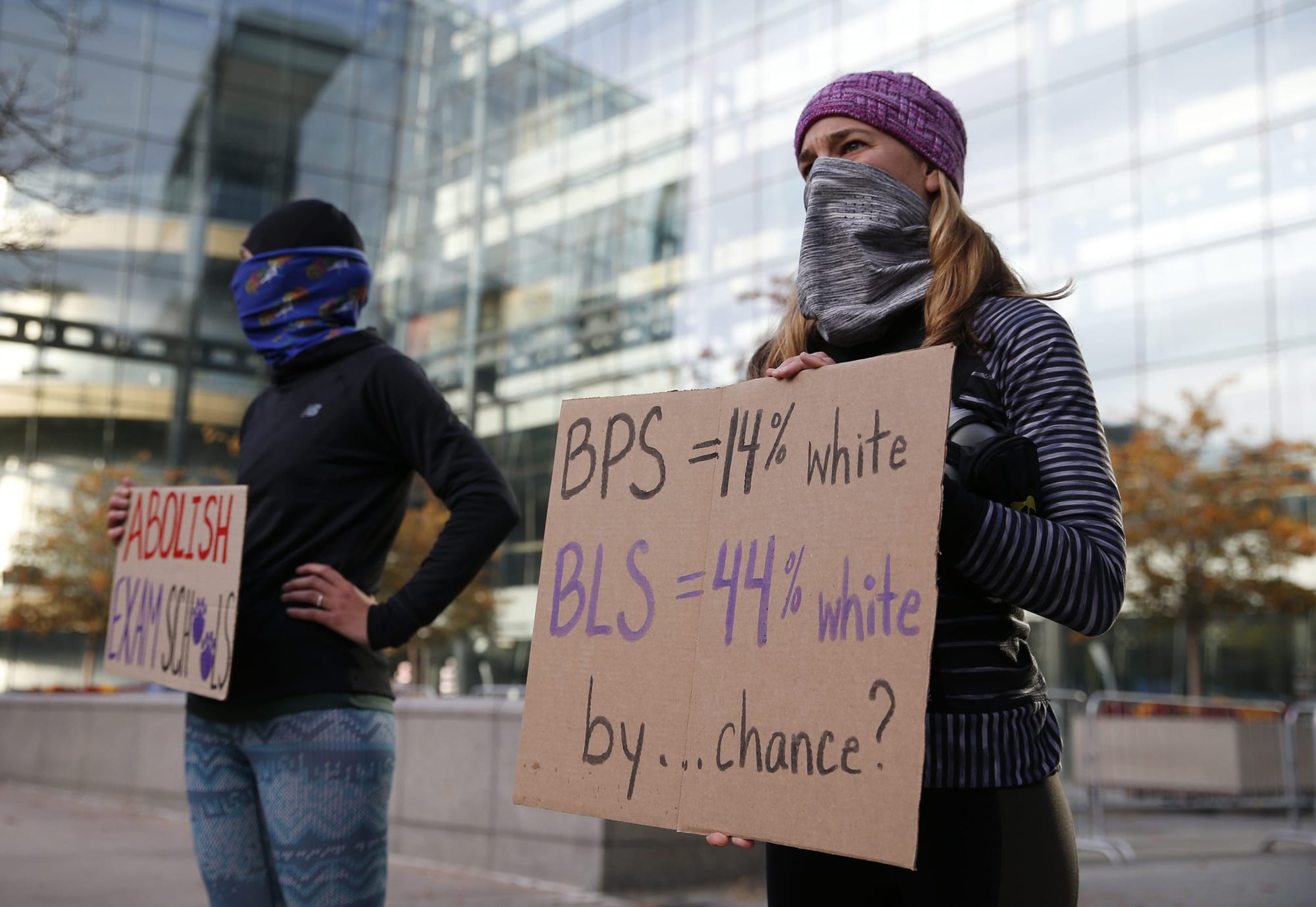
Even before it was passed, the 2020 change sparked intense debate and marathon committee hearings. Detractors at sidewalk protests called for a return to the traditional entrance exam, while supporters of the change highlighted the ways that test prep can exacerbate social inequalities.
The initial legal challenge
A few months later in February 2021, the Boston Parent Coalition for Academic Excellence, represented by the Pacific Legal Foundation, filed its first lawsuit. The group called the new policy a “wholly-irrational quota system based on zip codes.” The lawsuit was filed on behalf of 14 white and Asian parents and their sixth grade children who had applied to at least one of the exam schools for that coming fall.
Meanwhile, data coming out that spring showed that diversity among admitted students improved, with the biggest measurable change in socioeconomic diversity. The admitted student pool saw an increase of 6 percentage points among Black students, 4 percentage points among Latinx students, and 15 percentage points among low-income students. (The percentage of white and Asian students each dropped by several points, although their share of the pool was still disproportionately higher than their share of the school district.)
That double-digit jump among low-income students speaks to both the well-known racial wealth gap in Boston and the enduring economic inequality that cuts across race in the city. Roughly one-fifth of Boston’s population lives in poverty, with a roughly equal split in absolute numbers between poor white, Black, and Latinx residents.
A federal judge ruled against the lawsuit in April 2021. A few months later, the city’s school committee unanimously approved an overhaul of the exam school admissions process. The new policy essentially built on the pandemic-era policy, but instead of grouping applicants by ZIP codes, it grouped them in “tiers” based on a neighborhood’s socioeconomic conditions. The new policy also once again included the entrance exam, but gave more weight to grades compared with test scores.
The Boston Parent Coalition appealed the dismissal, but a federal appeals court ruled against them two years later in December 2023. One of the judges on the three-judge appellate panel wrote that the Supreme Court had affirmed that using socioeconomic factors to increase diversity was not the same as giving advantages to students of a certain race.
The updated policy once again increased racial diversity at the schools, but with it came reports of racist and classist pushback: One student told a local news outlet that upperclassmen openly viewed younger students admitted under the new policy as less-deserving to be there.
Meanwhile, the Boston Parent Coalition brought its fight to the Supreme Court. In its petition, the group argued that the Massachusetts 1st Circuit Court had allowed “racial balancing by proxy” in upholding the city’s pandemic-era ZIP code admission plan. They claimed that trying to achieve a racial makeup at the exam schools that was more in line with the racial makeup of the school district violated equal protection under the law.
The Supreme Court declined in December 2024 to hear the case, with Justice Neil Gorsuch writing the denial was based on the fact that Boston had, by that time, moved on to a different policy. He noted the ruling did not mean the Supreme Court agreed with the decision or opinion of the lower court.
A second attempt
In July, the Boston Parent Coalition filed suit again, saying the school committee had “been consumed with changing the racial composition of students at the Exam Schools.” This, they contended, was “contrary to the basic American ideal that people should be treated as individuals, not as interchangeable members of their racial groups.”
Just a few months later, in November, Boston changed the exam school admissions policy again in a way that critics said threatens to roll back recent diversity gains. The new policy reserves 20% of seats for students with the highest composite scores citywide; for the other 80% of seats, students have to compete only with others in their socioeconomic tier.
Keondré McClay, executive director of BEJA, one of the local organizations filing to intervene in the lawsuit, said the policy change—which heads in a direction more in-line with what Boston Parent Coalition would like by reintroducing citywide competition for 20% of seats—exacerbates historic inequality.
“This new formula favors white and Asian students as the old version of the exam school policy once did,” said McClay.
“We’re rolling back on policies that were created to … close the gaps within opportunity and achievement for Black and Latino students,” he added. “It just felt like a step backwards versus a step forward.”
Editorial Team:
Editorial Team:
Sahar Fatima, Lead Editor
Lara Witt, Top Editor
Stephanie Harris, Copy Editor
Eliza Dewey