Filed Under:
Israel’s destruction of Gaza’s courts leaves women at risk of domestic violence
Some women struggle to collect alimony from ex-husbands, while others continue to face abuse as divorce proceedings remain in limbo
Real journalists wrote and edited this (not AI). Independent, community-driven journalism survives because you back it. Donate to sustain Prism’s mission and the humans behind it.
Amal Rifaat Abu Sultan, 36, emerges from her dilapidated tent in the western part of Deir al-Balah, Gaza, at 6 a.m. Every day, she heads toward charity kitchens and humanitarian distribution centers to secure an early spot in the long lines before the food runs out—a daily, desperate race by a single mother to secure a few bites to eat for her three young children.
Abu Sultan fights this battle alone; she and her ex-husband divorced shortly before the start of the war. Israeli strikes have obliterated Gaza’s civic systems, meaning that Abu Sultan can no longer rely on government support or the court to compel her ex-husband to provide for his children.
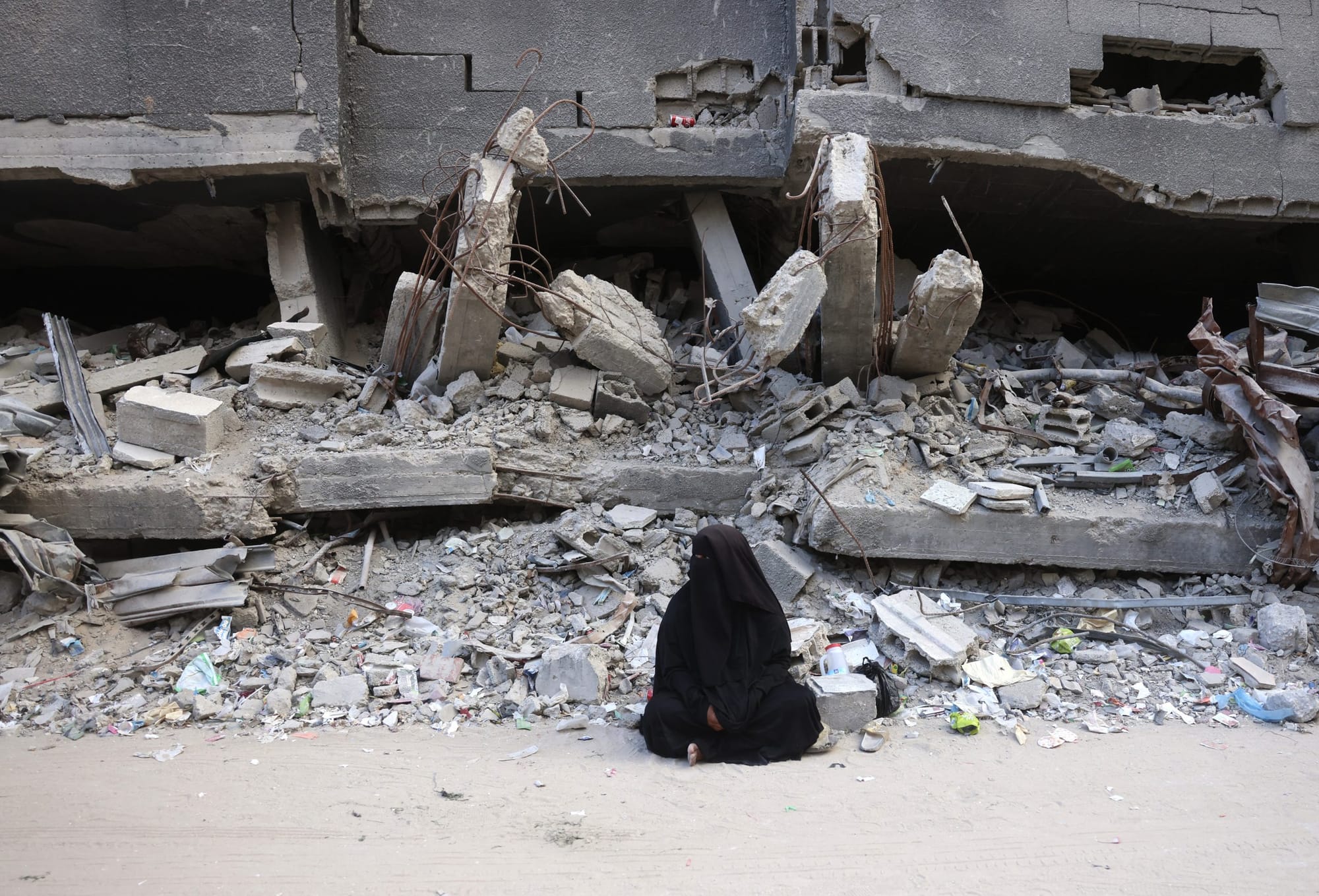
The family’s story highlights the silent institutional collapse striking the Gaza Strip: the complete erasure of the legal safety net for women due to Israel’s destruction of the courts and judicial system. With Sharia courts destroyed, digital databases lost, and law enforcement agencies and the police paralyzed, thousands of divorced and separated women are pushed into an absolute legal vacuum. They are left penniless and completely vulnerable to domestic violence, blackmail, and economic exploitation by the more influential parties in their families.
In Abu Sultan’s case, her ex-husband was unemployed and refused to comply with alimony orders. As such, during divorce proceedings, the Sharia court arranged for her to receive about $165 a month from the Palestinian Maintenance Fund. This government fund was designed to function as a social safety net, with authorities recovering the money from the husband later.
However, when Israeli airstrikes destroyed the main Sharia court building and its branches in Gaza, the fund was frozen, and the state’s administrative capacity to disburse money vanished. Abu Sultan’s monthly income dropped to zero while the market suffered from hyperinflation, with prices of essential commodities jumping by up to 400%.
Abu Sultan confronted her ex-husband inside the displacement camp and demanded her children’s alimony. According to the mother, he told her, “If there is a single judge left in this region, go and complain to him. The courts have disappeared, the police have disappeared, and there is no longer anyone to arrest me or force me to do anything. You will not get a single shekel from me after today.”
Institutional collapse and documentation of violations
Official human rights reports from local and international organizations indicate that the actual damage resulting from Israel’s destruction of the judicial system far exceeds the initial estimates of unresolved disputes. According to field documentation published by the International Commission to Support Palestinians’ Rights, this massive destruction of records has resulted in an unprecedented legal catastrophe: the loss of over 1.2 million legal files, court cases, and citizens’ vital records stored within judicial archives. This represents a systematic erasure of legal arguments, property deeds, and civil documentations, precipitating long-term legal chaos.
This institutional and judicial collapse intersects with a harrowing reality experienced by women. According to a report from the Palestinian Centre for Human Rights, while experiencing the complete absence of legal protections, women also face severe, multilayered gender-based violations due to the genocide.
The report found that, due to Israeli aggression, 61.12% of 800 surveyed women and girls experienced concurrent physical and psychological abuse, while 37.63% face severe economic deprivation and violence, triggered by the destruction of livelihoods.
In light of these conditions, human rights organizations monitored a rise in early marriage rates as a mechanism for survival intended to ease family economic pressures and overcrowding inside tents.
A legal vacuum
Aya Nasser, 22, got married a few months before the war. Nasser, who is using a pseudonym to avoid retaliation from her husband, said that married life quickly devolved into physical and verbal assaults inside a crowded shelter center. Nasser is now seven months pregnant and living in a tent with her family. She is no longer living with her husband because he subjected her to daily torture, and she said he exploited the absence of legal oversight to violently unload his own psychological trauma from the war onto her.
Nasser said she tried repeatedly to find a legal way out, walking long distances between tents and the temporary offices of displaced lawyers. Attorneys informed her that a divorce lawsuit based on harm requires official medical reports certified by government hospitals—facilities already overwhelmed with bombing casualties. She would also need a Sharia court convening with its full panel and officers who could notify her husband, none of which exists. Complicating matters further, Nasser said that in light of the disabled digital records, she was told that Sharia courts are refusing to divorce pregnant women, preferring instead to freeze the case until after childbirth to review custody, alimony, and the deferred dowry.
“I went to five lawyers, and every time the answer shocked me. They all told me that my case is almost impossible at the present time,” Nasser said. “Now, I am not practically married and I am not divorced; I am suspended in the air, and I do not possess a clear legal identity.”
I feel completely alone, trapped between my husband’s violence, my family’s pressures, and the absence of a law to protect me or a judge to do me justice.
Aya Nasser, Palestinian woman seeking divorce
“My family tells me, ‘Stay with your husband and endure him; this is not the time for divorce and courts,’” she added. “I feel completely alone, trapped between my husband’s violence, my family’s pressures, and the absence of a law to protect me or a judge to do me justice.”
Not far away, in the Nuseirat camp in the middle of the Gaza Strip, Palestine Abu Hajar, 30, a displaced woman and mother of six children, lives in a state of hypervigilance. She spends her day tracking her children’s movements, walking them to their temporary displacement school, and waiting to hold their hands all the way back to the tent.
Describing the reason for this suffocating surveillance, Abu Hajar said, “I die of terror every single second that my husband will come and kidnap the children and torture them. He takes strength from the complete absence of the state, and takes the children to pressure me and torture them physically and psychologically as a means to humiliate me.”
In the past, Abu Hajar said police patrols and court orders prevented him from approaching her family.
“For now, I am completely alone,” she said.
Collapse of civil protections and alternative justice
The intensification of violence against women comes amid Israel’s destruction and targeting of civil police headquarters and rehabilitation centers, leading to the absence of police and rampant chaos in the streets and camps, depriving women of protection against assault.
Women and girls in the Gaza Strip also face stifling societal pressures that compel them to remain silent about the abuse they endure. In a traditional environment further strained by catastrophic conditions, priority is given to maintaining family cohesion and public image at the expense of women’s personal safety.
In the absence of the official judiciary and executive security, tribal councils and family dignitaries have emerged to fill the administrative and leadership void. While these traditional councils adjudicate disputes based on customary practices to prevent violent interfamily clashes, the reliance on these councils represents a systemic shift, further rolling back women’s fundamental rights by entrenching patriarchal laws and male-dominated customs.
A report on gender-based violence issued by the United Nations Population Fund details how these tribal mechanisms exert harsh social and traditional pressures on Gaza’s vulnerable women. These pressures force them to completely waive their legal and financial rights—including deferred dowries, children’s alimony, and housing—as an unjust, mandatory condition to secure a “customary divorce” or simply to prevent the husband from forcibly abducting the children.
This crisis is exacerbated by the lack of equity in international and local aid distribution mechanisms. For example, humanitarian systems rely on digital lists noting the “head of the household,” so the husband’s name is registered exclusively as the recipient of aid and grants.
In the hands of abusers, this flaw turns humanitarian aid into a weapon of blackmail, allowing husbands to exploit relief by cutting off flour and water rations for their wives and children to force them into obedience or otherwise waive their rights. Women must effectively accept humiliation to secure a few bites of food to keep her children from starving to death.
“We are not just facing displacement from homes; we are facing a complete displacement from law and justice,” Abu Hajar said. “The absence of the court, the judge, and the policeman turned the tents into a jungle.”
Editorial Team:
Sahar Fatima, Lead Editor
Tina Vasquez, Top Editor
Stephanie Harris, Copy Editor
Enas Abu Ghayad
Filed Under: