Filed Under:
‘The bad men are going to come get me’: After San Diego mosque shooting, children grapple with trauma
The shooting at the Islamic Center of San Diego, which also houses a school, has left young children with lingering scars and reopened old wounds for their parents
Real journalists wrote and edited this (not AI). Independent, community-driven journalism survives because you back it. Donate to sustain Prism’s mission and the humans behind it.
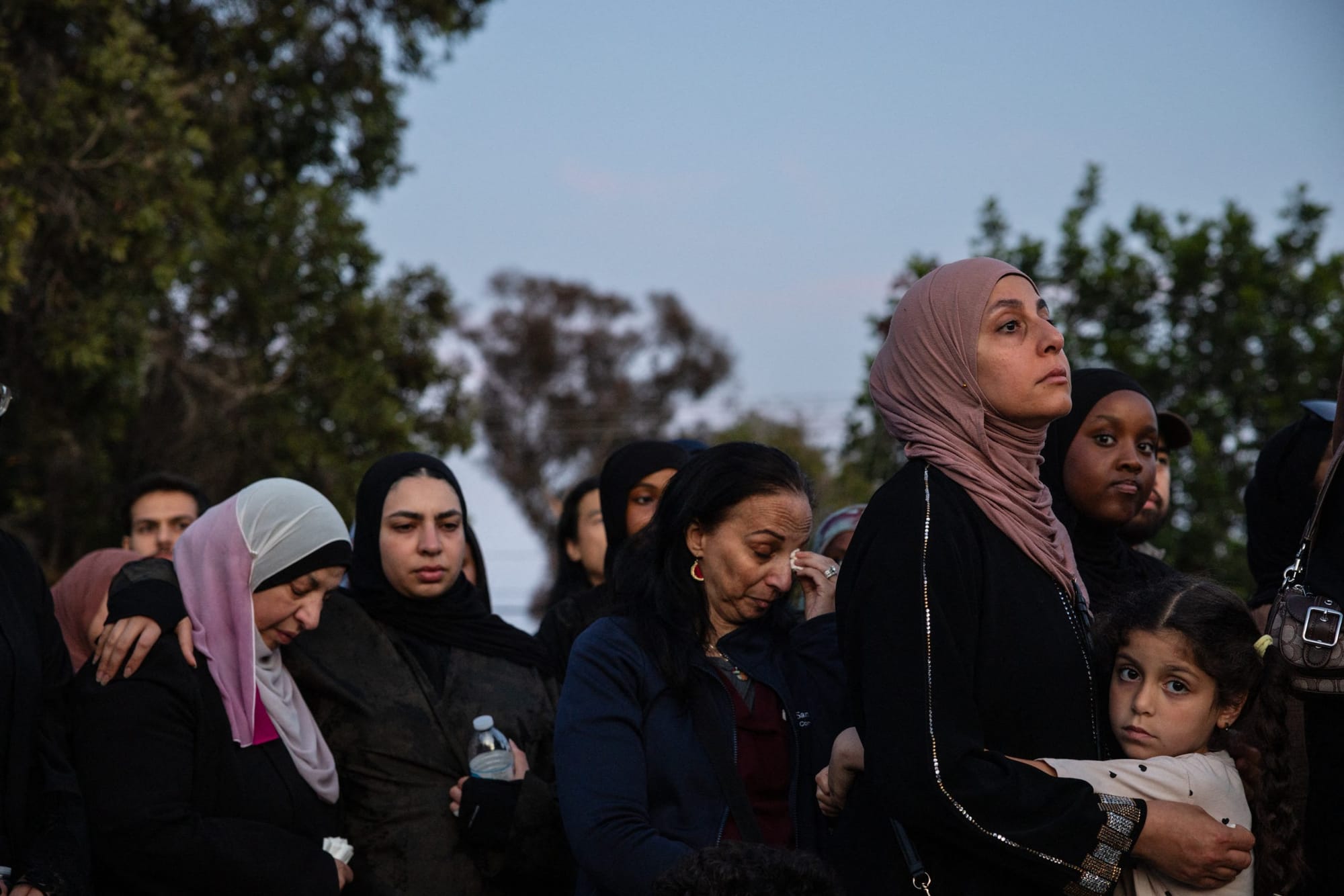
Suzanne Shama got word of an active shooter at her 6-year-old son’s school while driving. She felt like the blood left her body. Shama always feared this could happen, because the school was inside a mosque.
“This is where you go for safety, for identity, for purpose,” she said. The mosque and its school were the hub of her family’s life. But rising anti-Muslim sentiments had planted seeds of fear in her. Upon hearing of the shooting, she said, “My very first feeling was, oh my God, it’s happening.”
On May 18, two San Diego teenagers motivated by white nationalist ideology opened fire at the Islamic Center of San Diego (ICSD), home to Bright Horizon Academy, a full-time Islamic school whose lower campus includes over 100 students from pre-K to third grade. Hundreds of families like Shama’s are still living through the trauma of that day, according to parents, staff, and mental health professionals interviewed by Prism.
Therapists treating the families have found that the damage moves in every direction: Children’s fear activates parents’ older wounds, and parents struggle to provide the steadiness their children need to heal. Teachers who were inside the building that day are navigating their own trauma while preparing to walk back in to resume being the children’s safe adult when school restarts in August.
The shooting targeted both a mosque and a school, attacking children’s safety as well as their identity, community members say; healing, then, means ensuring they stay proud of exactly that.
Panicked aftermath
As soon as she heard of the shooting from a school staff member, Shama, a Bright Horizon board member, called the principal. Her son was with his first-grade class on the playground, near where the shooters entered. Staff took the children—including her son—into the principal’s office and hid in a small bathroom.
Shama rushed to the center. There, she saw the body of security guard Amin Abdullah, one of three men including Nadir Awad and Mansour Kaziha who were killed after drawing the gunmen away from the building, where 140 children were sheltering.
The police told her to get down; she hid behind a car and watched teachers and students evacuate to a nearby church, then joined them. Children were terrified and crying; so were the teachers, according to Iman Khatib, a teacher’s assistant. Inside, staff took attendance in each class. Khatib recalled staff falling to their knees when they realized every child was alive, repeating the shahadah, the testimony of faith.
“It was the one part of the day that offered any sense of relief,” Khatib said.
Eventually, the reunification began; parents had been arriving for hours. Louie Musa was one of them. His 9-year-old, Issa, had been inside the campus.
Musa, who is Palestinian and Jordanian, immigrated to the U.S. 15 years ago. He remembers dropping off his son hours earlier and seeing him chat with Abdullah, a regular morning ritual. It would be the last conversation either had with the security guard.
Musa, who works from home, learned of the shooting from a community group chat; the next minutes blurred as he began the 45-minute drive. When he finally held Issa, “I had a feeling very similar to the day he was born,” Musa said. It was the last uncomplicated emotion either would feel for a while.
Impact on children
Within days of the shooting, Amaly, a Muslim mental health nonprofit co-founded by therapists Halima Said and Amira Abudiab, organized healing circles drawing 150 to 200 attendees, joined by over 30 volunteer therapists. The early sessions were defined by shock and grief, the therapists told Prism; so many knew the three slain men personally. The school brought in trauma specialists for teachers and distributed a resource list to the community. It has also secured funding for security upgrades and mental health services.
Teachers and young students alike still remember the sound of gunshots, while some also saw Abdullah’s body before it was covered. The impact of these experiences varies across ages and developmental stages, according to therapists. Some younger children, they said, show regressive symptoms: bedwetting, clinginess, fear of being alone, jumping at loud noises.
Shama sees some of these symptoms in her son; he reacts to door knocks, the sound of the trash truck.
“In the first week, he was clearly running for cover,” she said.
Her son’s sleep is disturbed, and he’s been going to sleep with her. When she tried moving him to his own bed, he told her, “I’m scared the bad man is going to come. The bad men are going to come get me.”
Shama reassured him that he was safe. But, she said, “The damage is done.”
“He’s really struggling. I’ve had to start him on therapy sessions,” she said.
While the behavior is upsetting, it’s a normal trauma response at this age, Marwa Azab, a neuropsychologist working with the community, told Prism. “The nervous system is doing exactly what it’s supposed to do,” she said.
Other children have withdrawn or become hyperaroused. Musa has watched Issa oscillate between both: cranky, crying at things he didn’t before, or simply staring at the ceiling. “He’s pulling into himself,” Musa said.
Issa believes he should have done something, Musa said, maybe distracted the shooters. It’s hard for Musa to hear.
“You feel like you’re being tested with the most precious thing in your life,” Musa said.
About 10 days after the shooting, Issa took his toy guns, put on a hat and a vest, and set up a security booth with a beach umbrella outside his house. He’d wake at 9 a.m., have breakfast, and try to work a nine-hour shift patrolling the house or standing outside. The first time, Musa thought it was cute. By the second, with Issa outside for hours in the heat, he offered to pay for a full day of work if he came in early. But Issa insisted on staying out and even wanted to skip lunch. Later, Musa sat down to ask his son why he is doing all this.
“I don’t want anybody to come and shoot at us,” Issa told him.
How to talk to children
At the separate campus for older grades less than 15 minutes away from the mosque, a rumor spread that the shooters were headed there, sparking a lockdown. Shama’s 13-year-old helped barricade classroom doors.
With larger prefrontal cortexes, older children ruminate and demand answers, Azab explained; they wonder why their community is hated. The rumination can lead to anxiety and depression. “I don’t know what I feel, I don’t feel anything,” one child told Mariam Roashan, who has worked as a counselor with San Diego Unified School District for decades. That numbness has, in some cases, led to self-harm, according to some therapists Prism interviewed.
Roashan is no stranger to trauma. As a girl, she fled the Soviet invasion of Afghanistan that began in 1979, and still remembers how the rockets sounded. That experience drew her to her line of work. This summer, she and her colleagues are treating dozens of Bright Horizon students, teaching them how to regulate their emotions. The concern becomes more serious if symptoms worsen over time or a child’s personality radically shifts, she said.
Many parents struggle with what to tell their children, if at all. Azab said that narratives that restore safety are vital.
“Because the traumatic event doesn’t just teach a child about what happened, it also teaches the child about what to expect about the world,” she said.
Narratives that “shrink the safety space,” she said, include comments such as, “We’re never going to be safe” or “This always happens to people like us.” For older children, she said it’s better to reinforce that it’s not their Muslim identity that’s dangerous—“it’s hatred that’s dangerous.”
Shama had to have that conversation earlier than she planned. “You did nothing wrong just by virtue of existing as a Muslim,” she tells her older kids. “Maybe this catapults us into having a sense of purpose of what it means to have an Islamic identity.”
“This is our home”
Parents are trying to restore this safety while carrying their own pain. Many have difficult memories of post-9/11 days, have fled war-affected countries, or are struggling with recent family losses. “Reopening past wounds,” Abudiab, one of the therapists with Amaly, said, is “very consistent across the board” among families she has worked with after the shooting.
Azab has seen it in healing sessions: parents speaking about their kids, then pivoting into grief like a “cracked window” opening in a “dark basement.” She and other therapists see that the tragedy has created permission to address mental health in the community.
“As horrific as that is, it gave them a window of opportunity to heal for earlier pains, and I think that’s so powerful,” Azab said.
Gender colors recovery. Hijabi mothers are worried for their safety. Many of the men struggle to express their emotions, but are glad that initiatives like the healing circles exist. Musa remembers being worried about his son’s reaction when they attended Friday prayer after the shooting. Instead, Musa saw a friend at the mosque and ran into his arms, weeping.
“I don’t feel like there’s anything wrong with showing your feelings,” he said. “But we have to stay strong at the same time. We have to show the kids that ‘hey, Baba’s got it.’”
Shama, still grieving Abdullah herself, has channeled everything into her board work. “When things calm down,” she said, “I’m going to have my own therapy sessions.”
Parents aren’t the only impacted adults. The day after the shooting, Khatib and her colleagues returned to retrieve what they’d left behind during the evacuation. Walking back into the building felt like entering a haunted house, she said: doors broken down, books scattered across the floor.
“I felt like a shell of a human,” she said of that first week.
The attack destroyed her sense of safety. Loud noises like fireworks and motorcycles have become triggers; teachers are experiencing post-traumatic stress disorder, their therapists say. The trauma specialist Khatib is working with has helped blur the image of Abdullah’s body that was “burnt into my brain,” she said. “But I know with time, inshallah, I will find my new norm,” she said. “I’ll be able to restore myself.”
As the new semester approaches, some families are debating whether a mosque can be a safe location for a school. Some don’t want to lose the community, but share the unease around safety. Others are doubling down, more attached to Bright Horizon than before.
“This is more than our masjid and our school,” Shama said. “This is our home. This is ours.”
Meanwhile, Musa and his wife have been considering moving abroad. “Is this country really for us?” he wondered.
Roashan is optimistic. She thinks of a 7-year-old boy, jumpy and reluctant to come to counseling at first. She took him to the sandbox, where he started arranging toys of teachers and police officers, recreating the school. Then he mentioned his grandfather had died a few weeks earlier—another layer of loss. Two days later, the boy’s mother called Roashan; he wanted to see the therapist before the family traveled to Egypt. He’d been practicing the breathing techniques she’d taught him before bed.
“My message for families would be: What happened to your child and family do matter, and it may continue to affect you in different ways over time,” she said. “But trauma doesn’t have the final word.”
Correction, July 22, 2026: This story was updated to correct Suzanne Shama’s title. She is a board member of Bright Horizon Academy, not the Islamic Center of San Diego.
Editorial Team:
Sahar Fatima, Lead Editor
Lara Witt, Top Editor
Rashmee Kumar, Copy Editor
Hussain Khan
Filed Under: