South Florida organizers await ruling in gerrymandering lawsuit aiming to recognize Latinx community diversity
At the center of Cubanos Pa’Lante v. Florida House of Representatives are accusations that lawmakers drew districts by linking disparate neighborhoods, splitting established communities, and treating Latinx voters as a single political bloc
Alexandra Martinez
Real journalists wrote and edited this (not AI). Independent, community-driven journalism survives because you back it. Donate to sustain Prism’s mission and the humans behind it.
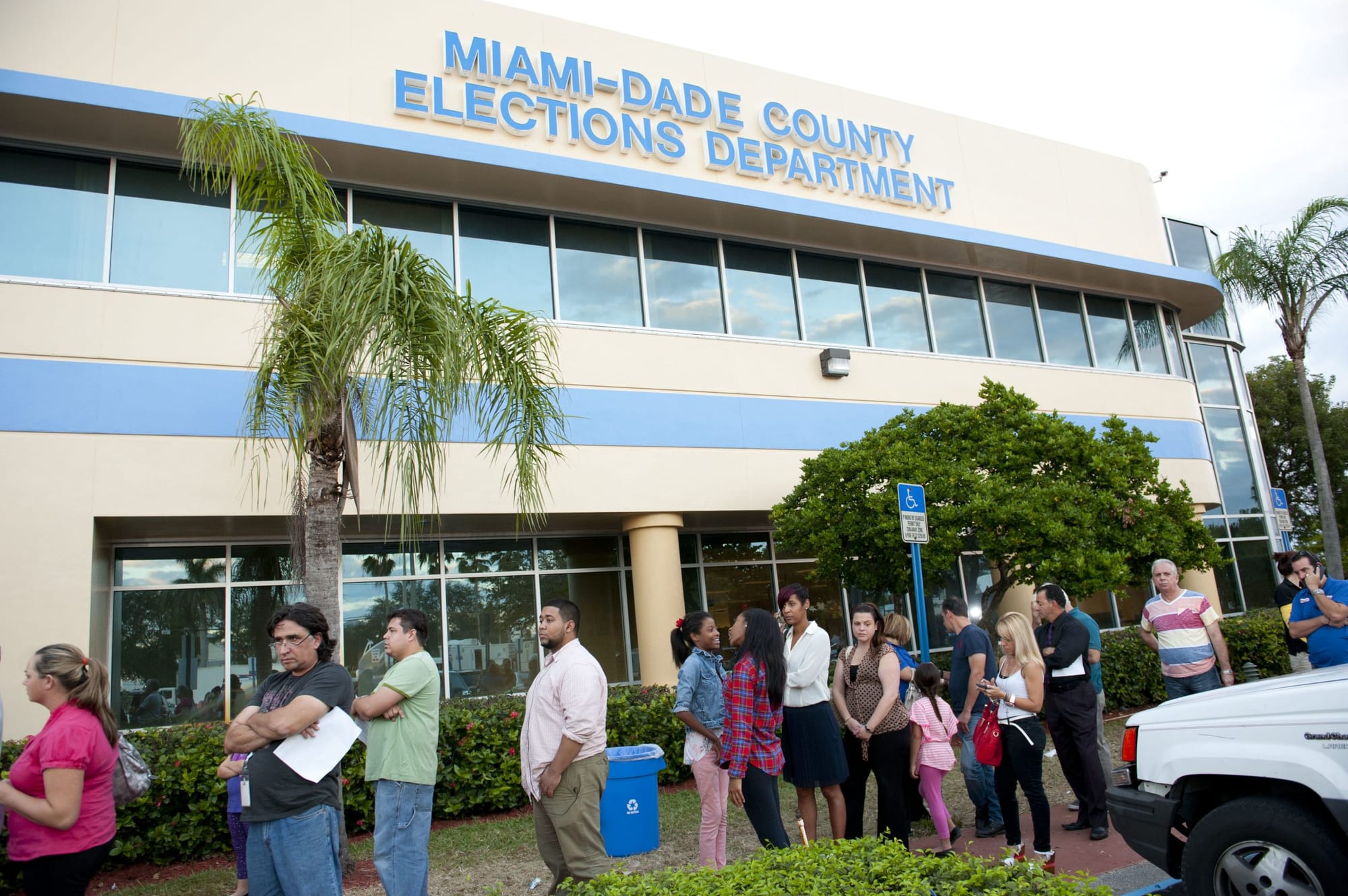
A coalition of South Florida community groups and voters are awaiting a court decision that will have serious ramifications for voter rights in Florida. The case is based on a lawsuit the groups filed that challenges Florida’s congressional and state House maps, an effort they say is rooted in a simple concern: whether Latinx communities are being fairly represented.
Cubanos Pa’Lante, et al. v. Florida House of Representatives, et al., filed in federal court in May 2024 by local residents, Cubanos Pa’lante, Engage Miami, and Florida International University’s American Civil Liberties Union (ACLU) Club, alleges that lawmakers racially gerrymandered several congressional and state House districts in South and Southwest Florida in violation of the 14th Amendment.
According to the complaint and subsequent legal filings, the plaintiffs argue that lawmakers drew districts by linking disparate neighborhoods, splitting established communities, and treating Latinx voters as though they form a single political bloc. In February 2025, a three-judge federal panel allowed the case to proceed, but only against eight of the 10 challenged districts, dismissing claims regarding two districts. The ACLU of Florida characterized the development as a significant step for South Florida’s Latinx community.
A trial was held in January, and the case is now before a three-judge panel. Plaintiffs such as Mike Rivero hope the court will send the issue back to lawmakers and force a new round of redistricting.
Rivero, a co-founder of Cubanos Pa’lante, an organization founded in 2020 to educate, organize, and mobilize progressive Cuban Americans, said the legal challenge grew out of the organization’s voter outreach work.
“What began as a grassroots group really started getting better organized, and a lot of the work we were doing was voter engagement, outreach, [and] voter registration,” Rivero said. “And we found that we kept encountering the problem of voter disenfranchisement. People didn’t want to vote. They don’t feel their vote counted.”
That frustration, he said, led organizers to look more closely at how districts were drawn in South Florida.
“People were feeling that way because their elected representatives weren’t capturing or adequately representing the community,” Rivero said. “So that was really the foundation of this case.”
These issues appear particularly visible in the 26th Congressional District, which includes areas as disparate as Hialeah and Immokalee. The former is the seventh-largest city by population in Florida, and the latter is an unincorporated community located more than 100 miles away.
“Just looking at Congressional District 26 as an example, you have parts of Miami-Dade, Doral, you have parts of western Hialeah area going all the way across the Everglades and involving areas of Immokalee, which are completely different communities,” he explained. “The needs of Immokalee are different from the needs of Doral. So why are they part of the same congressional district?”
For Rivero, the case highlights the many ways lawmakers fail to understand South Florida’s Latinx communities.
“Even within a city like Miami, we have such diversity,” Rivero said. “You have communities that are predominantly Cuban American, communities that are predominantly Venezuelan, and you have Nicaraguans in Sweetwater.”
Grouping these communities together under a single political identity distorts representation, he continued.
“So when you have the Florida Legislature looking at parts of South Florida as one group, it’s not a fair representation of what the people want [or] the point of view that people want to advocate for,” Rivero told Prism.
Cubanos Pa’lante’s co-founder said the coalition pursued litigation because it wanted a broader structural remedy—one that went beyond advocacy alone. The hope, Rivero said, is redistricting in South Florida that actually represents Latinx and other local communities. More broadly, the community groups behind the lawsuit also want more than “one-time change” in South Florida. According to Rivero, the broader goal is to put pressure on the legal system so that elected officials are forced to consider fair representation instead of “political gerrymandering.”
The case from South Florida also reflects a broader concern about democratic participation and political representation, Rivero said. In today’s landscape, he noted, it can be easy to forget that people are supposed to have a say in the ways their communities, their states, and their government are run.
“So we want to really empower our communities to not only take part in democracy, but reinforce that we do have a voice,” Rivero said. “Every vote does count.”
The South Florida community’s response to the lawsuit has largely been supportive, even as some residents are still learning the details of the case. Cubanos Pa’lante’s social media has helped locals better understand the gravity of the lawsuit and the importance of revisiting how the districts were drawn.
“There’s a segment of a population that does not really understand the nuances of it, which is a good opportunity for us to now have that conversation,” Rivero said. “And in those conversations, there’s a lot of eye-opening moments.”
Editorial Team:
Tina Vasquez, Lead Editor
Lara Witt, Top Editor
Stephanie Harris, Copy Editor
Alexandra Martinez