Filed Under:
After Trump’s speech, advocates say the real State of the Union is deepening instability
Critics took issue with President Donald Trump’s divisive rhetoric around immigrants and false claims about affordability

Alexandra Martinez
Real journalists wrote and edited this (not AI). Independent, community-driven journalism survives because you back it. Donate to sustain Prism’s mission and the humans behind it.
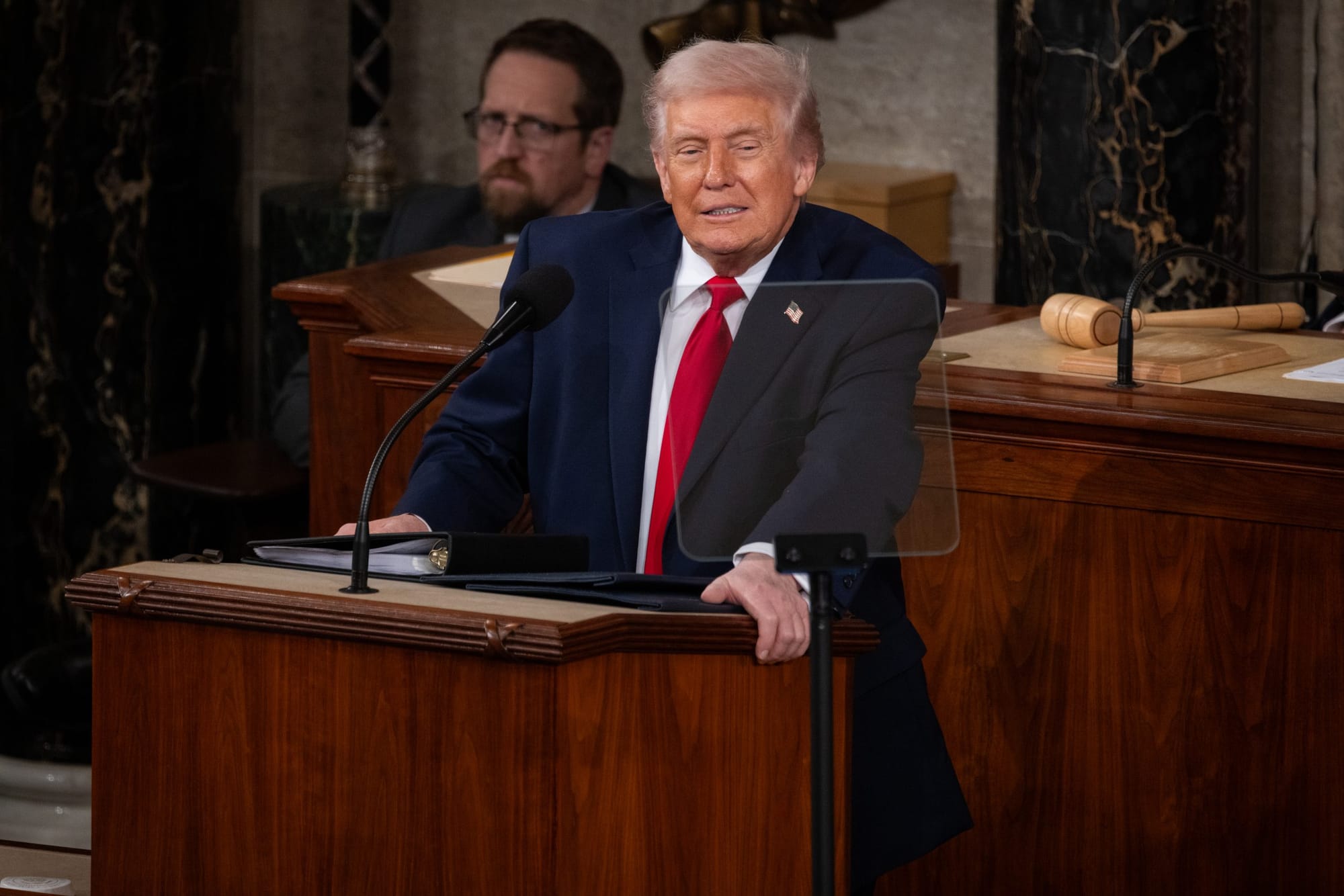
President Donald Trump used his State of the Union address Tuesday night to insist that the country is safer and richer under his second-term agenda. But across issues he spotlighted, including trade, affordability, immigration enforcement, and health care, key facts and recent developments undercut the White House narrative. Progressive groups and advocacy organizations say Trump’s rhetoric is designed to obscure the material fallout of his policies.
Rep. Summer Lee, D-Penn., delivering the Working Families Party’s response, said, “What we are witnessing from our government is authoritarianism. Any response that doesn’t acknowledge that truth is a disservice to Americans who deserve and need honesty right now.”
Here’s a look at some of the issues Trump spoke about.
Trump praised tariffs despite Supreme Court striking down his tariff power
Trump bragged about tariffs as a jobs-and-strength strategy. But days before his address, the U.S. Supreme Court ruled 6-3 that Trump overstepped his authority by using the International Emergency Economic Powers Act to impose sweeping import tariffs without Congress.
According to data from Econofact, the tariffs translate into higher input costs for businesses and often, higher prices for consumers; now the administration is scrambling for alternate paths as trade partners react and litigation grows. States have begun demanding refunds for tariff costs, and economists estimate that a large pool of tariff revenue may be eligible for refunds depending on how lower courts handle implementation.
Mi Familia Vota president and CEO Héctor Sánchez Barba anticipated this disconnect in a statement leading up to Trump’s speech.
“Thanks to Trump’s policies, we’ve experienced a relentless affordability crisis that continues to hurt American families,” Sánchez Barba said.
“Affordability” claims collide with Medicaid cuts and rising marketplace premiums
Trump promised affordability while backing policies that increase household costs. The Affordable Care Act’s (ACA) enhanced premium tax credits which have been expanded in recent years, expired at the end of 2025, and analysts estimate that as a result, average marketplace premium payments could rise sharply for many enrollees.
Meanwhile, the 2025 budget reconciliation law included major health care reductions. Health policy think tank KFF reports that the Congressional Budget Office estimated that the law would reduce federal health care spending by over $1 trillion and increase the number of uninsured by around 10 million. Separately, the Commonwealth Fund notes that Medicaid financing changes tied to provider taxes are projected to reduce federal Medicaid investments by nearly $226 billion over 10 years and contribute to millions losing coverage.
“President Trump’s State of the Union diverged significantly from the lived reality of Latino families,” Jessica Orozco Guttlein, senior vice president for policy and communications for Hispanic Federation, wrote in a post-speech statement. “[He] claimed that the economy is thriving while working families suffer under the weight of rising costs.”
In the Working Families Party response, Lee said, “Trump promised to lower our costs, instead he gave $1 trillion in tax breaks to the 1% while cutting your Medicaid and [Supplemental Nutrition Assistance Program benefits] by $1.1 trillion.”
Immigrants “draining” Medicaid doesn’t match the evidence
Trump’s anti-immigrant messaging routinely blurs a basic fact that undocumented immigrants are not eligible for federally funded Medicaid or ACA marketplace coverage, and that “Emergency Medicaid” is not the same program as full Medicaid benefits (a distinction advocates say is often erased in political speeches). A new Cato Institute white paper estimates that immigrants produced a large net fiscal surplus over recent decades in its analysis of taxes paid versus costs triggered.
During his speech, Trump addressed immigration in relation to national security and public safety. He praised border crackdowns, defended expanded Immigration and Customs Enforcement (ICE) operations, and blamed Democrats for what he described as weakened enforcement and rising threats tied to undocumented immigration.
“He celebrated aggressive federal enforcement that has traumatized neighborhoods across the nation,” wrote Orozco Guttlein, adding that the president employed “rhetoric that divides us, placing blame on vulnerable communities.”
Trump framed aggressive enforcement as restoring “law and order.” But advocates say the administration’s reliance on raids and expanded executive authority has deepened instability.
“ICE agents are hunting down human beings and cities are under siege,” Lee said in her response, arguing that Trump’s address “wasn’t a list of accomplishments. It was more like an obituary for the country working people built and a celebration for the billionaires who want to strip it for parts.”
Outside the House chamber, progressive groups staged a “People’s State of the Union” to elevate stories from communities impacted by immigration enforcement, budget cuts, and what they described as democratic backsliding. Rev. Paul Brandeis Raushenbush, who participated in the event, warned that the administration is weaponizing “a narrow idea of ‘religion’ to advance a repressive, authoritarian agenda.”
Trump’s Iran claims: from “obliterated” to looming nuclear threat
Trump also made claims about Iran’s nuclear program and the need to confront it. He reiterated past statements that the U.S. will “never allow … the world’s No. 1 sponsor of terror” to obtain a nuclear weapon, warning Congress that Tehran has “already developed missiles that can threaten Europe and our bases overseas, and they’re working to build missiles that will soon reach the United States of America.”
The Council on American-Islamic Relations said in a statement, “One of two things is true: either the war hawks around the President are lying to him about Iran to convince him to start a war or the President is not being honest with the American people.”
Last year, the administration celebrated U.S. and allied strikes on Iranian nuclear facilities as having “obliterated” Iran’s capability to pursue a bomb. But Trump has now been telling lawmakers that Iran is “starting it all over” and “pursuing their sinister ambitions.”
The National Iranian American Council (NIAC) has repeatedly pushed back against these claims, arguing that there is no military solution to Iran’s nuclear program and that threats of force risk destabilizing the region.
“It shouldn’t be normal for the President to make up things about a country being threatened with war on the podium at the State of the Union,” NIAC wrote on X. “Yet with the largest military build up in the Middle East since 2003, it’s hard not to recall George W. Bush’s false claims about Iraq pursuing nuclear, chemical and biological weapons during his infamous axis of evil speech 24 years ago.”
The organization called on Congress to bring war powers resolutions put forth by Reps. Ro Khanna, D-Calif., and Thomas Massie, D-Ky., and Sens. Tim Kaine, D-Va., and Rand Paul, D-Ky., up for a vote. The group also accused Congress of “dragging its feet on its all-important duty: protecting the United States and reflecting the will of the American people, who reject a new, disastrous war of choice with Iran.”
Editorial Team:
Sahar Fatima, Lead Editor
Lara Witt, Top Editor
Rashmee Kumar, Copy Editor
Alexandra Martinez
Filed Under: