Filed Under:
Supreme Court TPS ruling against Haitians sparks national outcry, rallies across the country
The Supreme Court last month cleared the way for the Trump administration to end Temporary Protected Status for Haitians and Syrians

Alexandra Martinez
Real journalists wrote and edited this (not AI). Independent, community-driven journalism survives because you back it. Donate to sustain Prism’s mission and the humans behind it.
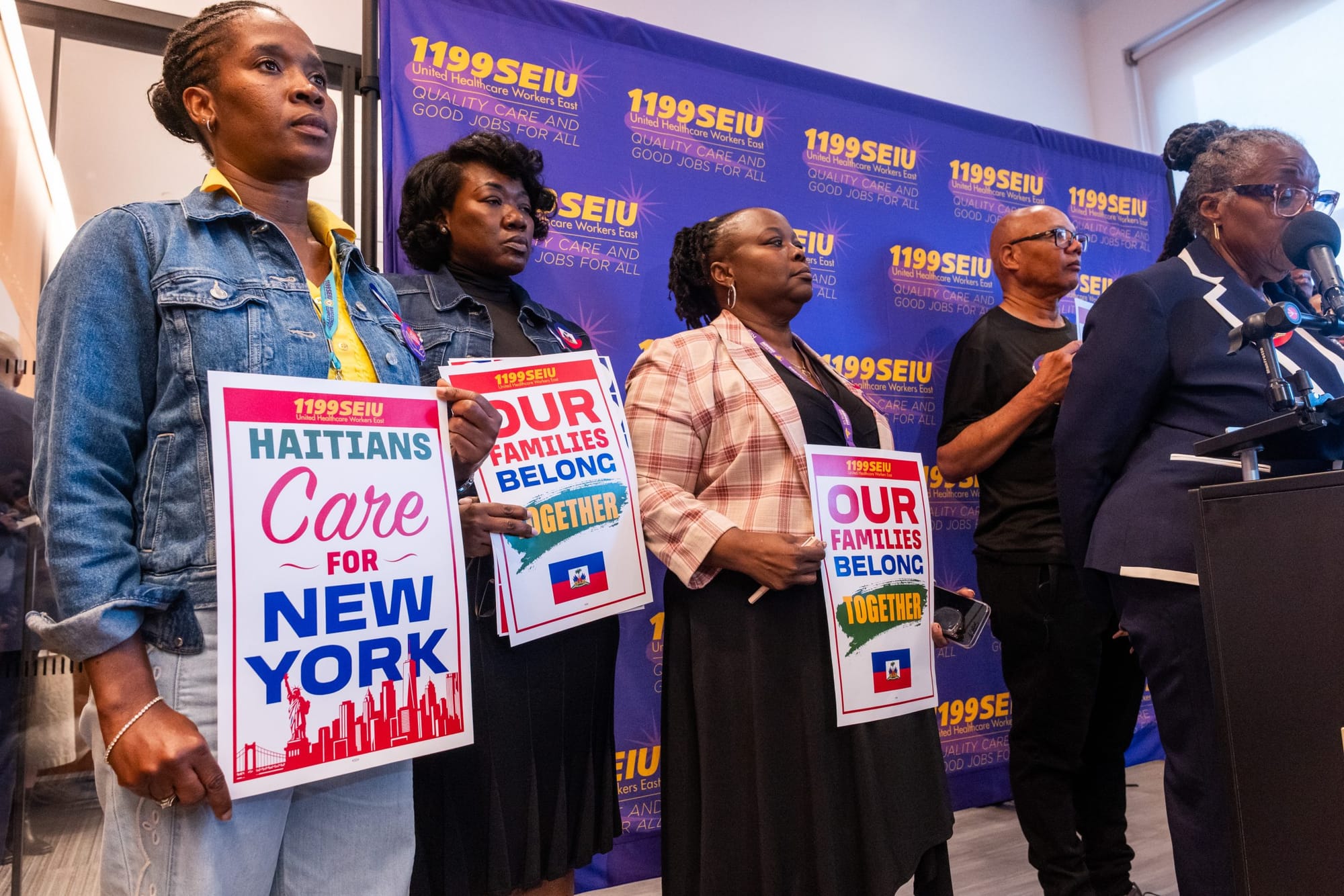
On the morning that the U.S. Supreme Court cleared the way for the Trump administration to end Temporary Protected Status (TPS) for Haitians and Syrians, Haitian Women for Haitian Refugees was preparing to host a workshop for survivors of gender-based violence. Instead, the Brooklyn, New York-based immigrant rights organization canceled the event.
For Executive Director Aline Gue, the day became one of fielding calls from frightened community members, reading through the court’s decision line by line, and helping families brace for what could come next.
“There was a real moment of grief and anger,” Gue said. “We know so many people who have TPS. To see a decision in black and white that completely devalues and disregards the humanity of so many people we love … was really hard.”
Immigrant rights organizations across the country are mobilizing following the Supreme Court decision. Advocates said the ruling could have sweeping consequences for more than 1.3 million TPS holders nationwide.
The ruling prompted demonstrations nationwide.
In South Florida, immigrant rights organizations held a “National TPS Rally” on July 9 at the Little Haiti Cultural Center in Miami, joining coordinated actions taking place across the country. South Florida is home to one of the nation’s largest Haitian American communities, making the issue particularly significant in the region.
In the 6-3 decision issued June 25, the Supreme Court ruled in favor of the administration in two closely watched cases: Mullin v. Doe and Trump v. Miot. The court consolidated the cases into Mullin v. Doe. Legal challenges continue as work authorization for Haitians and Syrians is set to expire on July 24 and July 17, respectively, though legal experts say these dates are placeholders.
The ruling did not permanently resolve the underlying legal challenge but reversed a lower court order that had temporarily blocked the Trump administration from ending Haiti’s TPS designation.
In its opinion, the court held that federal courts generally lack the authority to review most nonconstitutional challenges to TPS termination decisions, even if plaintiffs argue that the government failed to follow required administrative procedures. The majority also concluded that the plaintiffs were unlikely to succeed in their equal protection claim alleging racial discrimination, finding that statements cited in the lawsuit—including comments that Haitians were “eating dogs and cats,” that “all Haitians have AIDS,” and references to immigrants “poisoning the blood” of the U.S.—were insufficient to establish unconstitutional racial animus.
As a result, the court lifted the preliminary injunction that had prevented the administration from moving forward while the litigation continues.
TPS is a humanitarian program created by Congress that allows individuals from countries experiencing armed conflict, natural disasters, or other extraordinary conditions to live and work legally in the U.S. until it is deemed safe to return.
Civil rights organizations, including the American Civil Liberties Union of Northern California, said the ruling places hundreds of thousands of families at risk of losing their legal work authorization and protection from deportation. For many Haitian advocacy organizations, the ruling was not unexpected.
“We were planning for this possibility,” Gue said. “We started doing community defense workshops and preparedness workshops.”
Still, Gue said seeing the ruling become reality was devastating. The organization has since shifted its focus toward emergency preparedness, expanding “know your rights” trainings, Immigration and Customs Enforcement watch efforts, mutual aid networks, and court accompaniment for Haitian families who could lose their legal status.
Gue said the court’s decision weakens judicial oversight of future administrative actions affecting TPS holders.
“The decision has left very little accountability for the Trump administration to do whatever it wants,” Gue said. “People are faced with ‘what do I do with the life I’ve built here?’”
According to Gue, members of her organization have already reported losing jobs despite TPS protections technically remaining in effect during portions of the legal process, leaving families increasingly vulnerable to economic hardship and deportation.
Many Haitian TPS holders live in mixed-status families, where U.S. citizen children, lawful permanent residents, and TPS recipients live under the same roof. Ending TPS could separate families who have lived in the U.S. for decades.
Following the decision, immigrant advocacy organizations have renewed calls for Congress to create a permanent pathway to citizenship for TPS holders.
United We Dream, an immigrant youth-led organization, described the ruling in a press release as paving the way for what it called “the largest delegalization effort in modern U.S. history,” arguing that ending TPS threatens both the more than 1.3 million individuals currently protected under the program and millions of U.S. citizen relatives connected to TPS recipients.
The Pennsylvania Immigration Coalition (PIC), meanwhile, said the decision threatens immigrant families throughout the state and urged Gov. Josh Shapiro to limit state cooperation with federal immigration enforcement, while also calling on Congress to enact permanent protections for TPS holders.
“Belonging means knowing your family can build a future without living under the constant threat of separation,” said Jean Guillaume, executive director of Reclaim Hayti, a member of PIC’s coalition and Pennsylvania’s Haitian community. “For Haitian families in Pennsylvania, this decision is not about politics or paperwork, it is about whether our children can continue growing up in the communities they call home.”
In Brooklyn, Gue said, “We will continue to fight and survive.” They added, “This community has been weathering some very actively, intentionally violent anti-immigrant, anti-Haitian policies for decades.”
Haitian Women for Haitian Refugees is also advocating for Senate Bill 4814, which would extend TPS for Haitians through 2029, while continuing to push for broader immigration reform that would provide a pathway to permanent residency and citizenship for longtime TPS holders.
Gue said the Supreme Court decision should be viewed within the broader history of U.S. immigration policy toward Haitians and other Black immigrants.
“This is all a part of a very concerted effort to shift the demographics of this country,” they said. “We know that this system has anti-Blackness and anti-Haitianism deeply embedded into the foundation. I think we need to call it what it is. And all the alarms need to go off, across the board.”
Editorial Team:
Sahar Fatima, Lead Editor
Lara Witt, Top Editor
Stephanie Harris, Copy Editor
Alexandra Martinez
Filed Under: