These peace groups are challenging Trump’s war on Iran
Activists are raising awareness of the human and economic costs of a deeply unpopular war that drove midterm election voters away from Republicans

Kourosh Ziabari
Real journalists wrote and edited this (not AI). Independent, community-driven journalism survives because you back it. Donate to sustain Prism’s mission and the humans behind it.
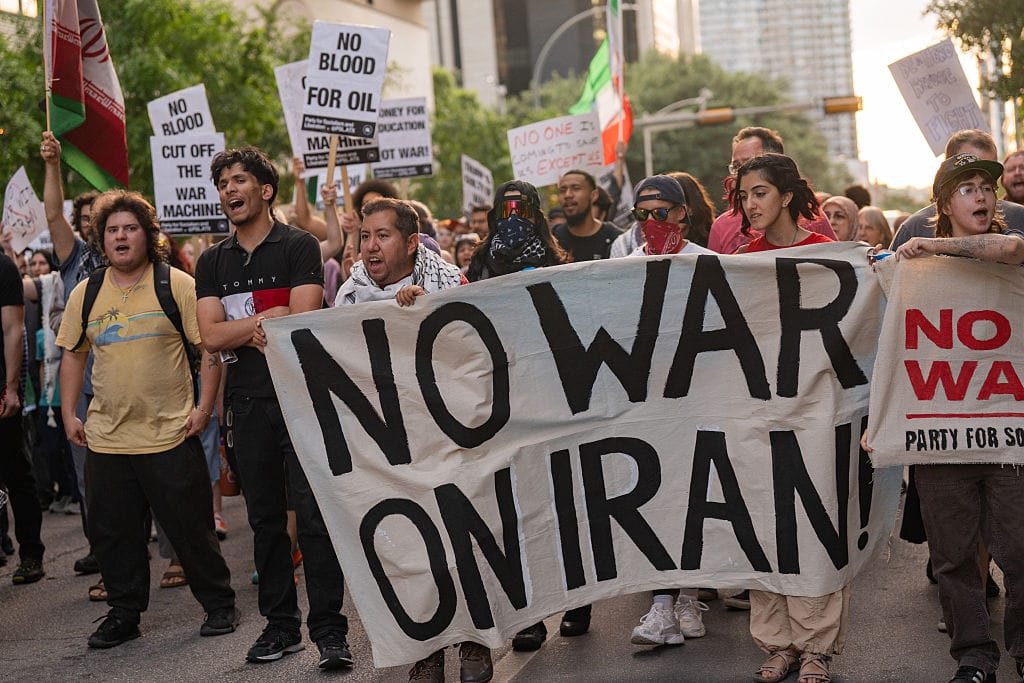
The war on Iran has been documented as the most unpopular conflict the U.S. has ever initiated. Exit polling from NBC News shows that 74% of voters in the November midterm elections considered the war a crucial or major decision-making factor, leading to a sweeping victory for the Democratic Party. Still, this widespread opposition to the war hasn’t led to scenes of mass protests nationwide.
The Trump administration’s months-long crackdown on universities to stifle student protests in response to the genocide in Gaza has blanketed universities in fear, discouraging political activism on campus. Media organizations have also been repeatedly pressured by federal regulators into offering “patriotic” coverage of the Iran war, which effectively means presenting less critical perspectives.
In this restrictive environment, peace activists and independent advocacy organizations have emerged as the most visible envoys of the anti-war movement in America, raising awareness of the human cost of the military campaign in Iran and the consequences of instability in a region critical to the smooth supply of energy.
Through vigils, gatherings, memorials, outreach to politicians, and online advocacy, peace activists and nonprofits have challenged a war that many Americans believe has been waged on behalf of Israel, including 56% of participants in an IMEU Policy Project and Demand Progress survey in March who said they thought the war benefited Israel more than the U.S.
In Dayton, Ohio, where America’s largest brick-and-mortar peace museum is located, the museum’s former director organized an art installation in April commemorating the 120 children who were killed in U.S. airstrikes on the Shajareh Tayyebeh Elementary School in Minab on Feb. 28. The Pentagon has not yet published its investigation into the attacks.
“The bombing of the school in Minab was heartbreaking. As a father and grandfather, I cannot imagine the grief of those families,” Steve Fryburg, who is also an Army veteran, told Prism.
“When children become casualties of our military actions, we lose something far more important than international standing. We lose our moral credibility,” Fryburg said, adding that the world will remember the children of Minab long after the political justifications for the war have been exhausted.
At the “Eyes of a Child–Children of Minab” memorial, dozens of schoolbags representing the students killed in Minab, with portraits identifying each of them, were placed outside the office of Republican Rep. Mike Turner of Ohio’s 10th Congressional district. Turner lost his seat, held since 2003, to Democrat Kristina Knickerbocker earlier this month.
Fryburg had visited Iran twice in 2006 and 2007, where he befriended Shahriar Khateri, a physician and veteran of the Iran-Iraq War, who was exposed to chemical weapons used by the former Iraqi dictator Saddam Hussein. Fryburg served in an advisory capacity to help Khateri launch the Tehran Peace Museum in 2011.
“Our local Veterans for Peace chapter has supported a Veterans for Peace national billboard campaign, including billboards near Wright-Patterson Air Force Base reminding military personnel of their obligation to refuse illegal orders,” Fryburg said. “Our purpose is to move beyond statistics and political rhetoric and remind people that every casualty represents a human life, a family, and a future that will never be realized.”
Despite President Donald Trump declaring dozens of times this year that an agreement with Iran was imminent, there is no indication that the war, which began with joint U.S. and Israeli strikes on Iran in February, will end any time soon. Although there is no kinetic action playing out at this stage, the U.S. military is enforcing a full naval blockade to prevent Iran from importing and exporting goods, and the White House has been pressuring Iran’s neighbors into halting their trade ties with Tehran.
As criticism of the war grows, one group in the crosshairs of the Trump administration due to its vocal opposition to U.S. foreign policy is Code Pink: Women for Peace. A women-led anti-war movement founded in 2002 in the run-up to the invasion of Iraq, the group has consistently advocated for Tehran-Washington reconciliations and organized a 10-day trip to Iran in 2019.
The group’s co-founder Medea Benjamin has been closely involved in promoting peace with Iran. She was also part of the group’s delegation that traveled to Iran and visited the cities of Tehran, Isfahan, and Shiraz. Benjamin and her friends have been seen in several videos on social media disrupting events featuring Secretary of Defense Pete Hegseth, drawing attention to the civilian toll of the war against Iran.
“We have maintained a constant presence in Congress, confronted officials responsible for the war, organized protests, built coalitions with Iranian Americans, veterans, and other peace organizations, and pushed legislators to invoke the War Powers Resolution and oppose additional war funding,” Benjamin told Prism.
“We are particularly focused on the bombing of the girls’ school in Minab, where so many children were killed, and on attacks against civilian infrastructure. These incidents demand independent investigations,” she said.
“We refuse to let these deaths disappear behind military jargon or official claims of collateral damage,” she added, pointing to the responsibility of the incoming Congress to demand accountability for war crimes by requesting military records and subpoenaing the officials involved in the plans.
Code Pink’s denunciation of Trump’s authoritarian agenda has come with a price, and the group is under investigation by the Department of the Treasury for organizing a humanitarian trip to Cuba in March challenging the U.S. embargo against the island nation. The State Department also accused Code Pink of being a party-line advocate for “anti-American foreign states” in a 100-page July report.
Benjamin believes the biggest challenges in the peace movement include the disconnect between public opinion and government policy, Congress’ failure to exercise its constitutional authority, and the mainstream media’s tendency to amplify hawkish narratives, which she said is partly fueled by the pro-Israel lobby. Still, she argued that the lack of a visible movement similar to the massive Vietnam War protests shouldn’t be mistaken for a lack of disapproval.
During the Vietnam War, Benjamin said, the conflict was deeply personal for millions of young Americans who were drafted into military service, while most Americans are “far removed from the violence inflicted in their name” in Iran. In addition, the suppression of pro-Palestine protests since 2023 “has sent a frightening message about the consequences of political activism,” Benjamin said.
Despite these limitations, groups across the political spectrum have coalesced around the goal of ending the war and demanding accountability. Their efforts may not have been highlighted on cable TV, but their work continues even without sustained media coverage, a luxury that has been afforded to pro-war voices more generously.
The Quaker-founded American Friends Service Committee (AFSC), established in 1917, has been a fixture of anti-war events since the U.S. joined the Israeli regime to attack Iran. On Veterans Day, the group joined several other peace organizations in hosting a candlelight vigil in Atlanta honoring the children of Minab and other victims of the war.
Kerri Kennedy, AFSC’s international associate general secretary, said that despite the chilling effects of the Trump administration’s threats against nonprofit organizations, the work to advocate for peace will not be abandoned.
“We will continue to participate in protests and vigils and urge our supporters to call their members of Congress to demand action,” she said.
While Kennedy agrees that reactions to the war in Iran have been different from what was seen in the 1960s after the Vietnam War, she believes the national response has been significant.
“There are a number of reasons why this moment differs from the Vietnam War era, and of course we would like to see continued and increased mass mobilization to stop this unjust, illegal, and unprovoked war,” she told Prism. “But we would reject the characterization that we haven’t seen a nationwide protest movement.”
Kourosh Ziabari