Filed Under:
Under the mulberry tree: A story about friendship in prison
Relationships are often severed by the carceral system, but a prison transfer ultimately led me back to my old friend Crazy Horse
Real journalists wrote and edited this (not AI). Independent, community-driven journalism survives because you back it. Donate to sustain Prism’s mission and the humans behind it.
Everyone who puts on state-issued blues, otherwise known as the Illinois Department of Corrections uniform, comes in with the mindset that there are no friends in prison. This attitude is most common in maximum security prisons, where people have been found guilty of serious crimes such as murder and are serving sentences of more than 20 years.
As a cellmate once said, “It’s kind of hard to befriend someone when you hear what they did to get here.”
But as we adapt to our environment—one in which we are forced to be in close proximity—bonds do form. But these connections can also be broken by the prison’s administration at the drop of a dime.
Life behind bars
I came to the penitentiary in 2000, when I was 17. At my young age, I couldn’t comprehend the magnitude of having to serve a 45-year sentence. For the first few years of my incarceration, I assumed l would serve maybe eight years at most before regaining my freedom through the legal system. This belief was a coping mechanism, and a sign of my immaturity. Few ever really accept their incarcerated fates.
One exception was a man who went by the name Crazy Horse. At the time, he was in his early- to mid-40s, white, tall, and slender, with long hair and a mustache.
He looked like an old-school biker straight out of “Easy Rider.” When I met him, he’d recently been transferred from death row, where he was incarcerated for over a decade before former Gov. Rob Blagojevich abolished the death penalty in Illinois, allowing people to escape the dreaded needle and instead serve life in prison.
As my eight-year mark came and went, I was learning to cope with the reality of my sentence. I asked Crazy Horse how he managed to think about spending his life behind bars.
“Shankster,” he started. “I was a dead man. Every day l’d wake up not knowing if this was the day l’d take that long walk and be killed by the state, so I’m grateful for a life sentence. I can now wake up and not see the reaper’s shadow on my back. So l’m basically telling you that it could be worse.”
“How is that of any help?” I said. “I can see why they call you Crazy Horse now.” We both burst into laughter.
A rare, tender moment
Everyone doing serious time in a maximum security prison shares the same struggles against the injustices of the criminal legal system, correctional officers, etc. Thus, we have an unspoken understanding that we are in this together. Crazy Horse knew this better than others, which is why we became good friends. Of the 18 years I did in Illinois’ Stateville Correctional Center—before I was transferred to another prison—Crazy Horse was there for about half of them.
As the years passed at my new prison, l would run into people I hadn’t seen in over a decade. A lot of them were much older, and some had serious health problems. Some were people I considered friends; others were just faces I knew. It didn’t really matter. We always had at least one person in common, and we’d use them as a conversation starter. Through these conversations, I learned who passed away or who got transferred. Unfortunately, there was almost never a word on anyone getting released.
I’d always ask about Crazy Horse, but no one seemed to know of his whereabouts. He was a ghost roaming concrete walls.
After another transfer, I arrived at Illinois’ medium security Dixon Correctional Center, which was a completely different environment than I was used to. I went from being stuck in a cell all day to having the freedom to come and go into our unit’s recreational day room. One day as I explored the laundry room, where there are two washers and dryers we can use at any time, I heard the sound of a horse neighing.
When I turned around, there was Crazy Horse with a big grin on his face.
“What up, mofo?” he said. “You need me to teach you how to use the washing machine?”
“Yeah, actually, I do,” I said. “Good to see you’re still useful in your old age.”
We both laughed, embraced, and began trading stories of our experiences over the years.
Since the start of the pandemic, we’ve both been at Dixon. We’ve seen many of our elderly comrades die from the virus. We are both survivors though, and we’ve even taken up new jobs. Crazy Horse traded in his Harley Davidson for a John Deere mower. He now rides around the compound working as a landscaper. I work as a gardener in charge of 3.5 acres of land, a green house, and a hydroponics room.
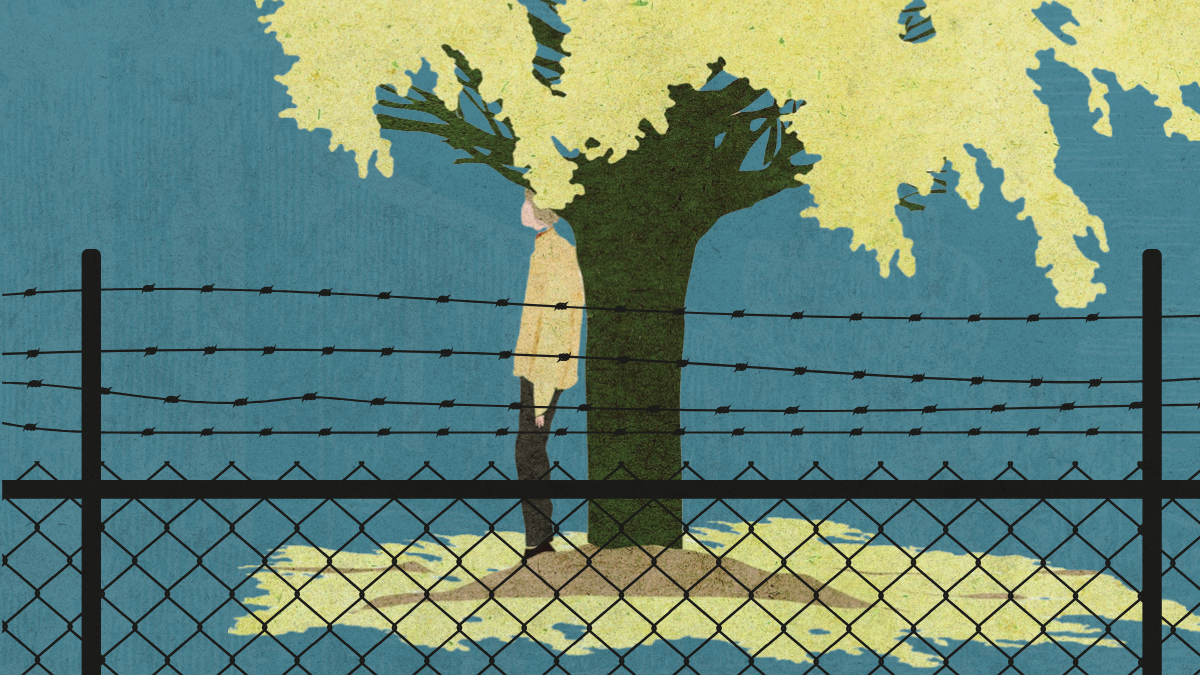
One week, I saw Crazy Horse driving by my garden, and I waved him over. I’d just picked a ripe watermelon and split it open, sharing it with the other workers. l shared my portion with Crazy Horse. As we stood under a mulberry tree for shade, spitting out seeds, a realization hit me.
“Would you have imagined us back then, standing under a mulberry tree eating damn watermelon?” I asked.
“Hell no,” he responded.
He jumped back on his John Deere and drove away, thanking me for the watermelon, a delicacy we never had in other prisons. I stood there a while longer, savoring the last bite, grateful for these rare, tender moments behind the wall.
Editorial Team:
Rikki Li, Lead Editor
Tina Vasquez, Top Editor
Stephanie Harris, Copy Editor
Juan Hernandez
Filed Under: