Filed Under:
Prison telecom companies rake in billions exploiting incarcerated people. They donate a fraction of profits to those they harm
ViaPath and Aventiv Technologies give small grants to organizations helping systems-impacted families, dividing advocates on the ethics of accepting donations

Tatiana Walk-Morris
Real journalists wrote and edited this (not AI). Independent, community-driven journalism survives because you back it. Donate to sustain Prism’s mission and the humans behind it.
When Ashley Baker won a $5,000 scholarship from a Maryland nonprofit that supports foster care youth, the money—and the relationship she developed with the charity—got her through a troubling time in her life.
The 24-year-old spent much of her childhood in foster care, first from the ages of 1 to 3 and then again from 14 to 21 years old. In total, she bounced between 14 homes and seven high schools, she said. It was actually her caseworker who encouraged her to apply for a Comfort Cases scholarship, which she was awarded in September 2022 shortly after beginning her semester at East Stroudsburg University in Pennsylvania. Two weeks after she found out she won the scholarship, she was sexually assaulted by another student. The scholarship helped sustain her because she wasn’t working at that time, she told Prism.
Along with the funds, Baker was paired with a mentor who sent care packages stuffed with Trader Joe’s snacks, toothpaste, toothbrushes, and other essentials from Comfort Cases, based in Rockville, Maryland. The youth foster care organization works across the U.S., the United Kingdom, and Puerto Rico providing young people in foster care with backpacks filled with new items, such as pajamas, blankets, stuffed animals, and other age-appropriate supplies. The packages also come with cards, which Baker still has. “It was always nice to know at least I was on someone’s mind. I was very isolated,” she said.
“I became really close with Jill,” Baker explained, referring to her mentor and Comfort Cases’ board president, Jill Ross. “She just always knew what was me. … Somehow she just knew what to put in that box to make me feel better.”
What Baker did not know at the time was that the support offered by Comfort Cases was made possible in part through donations from the ViaPath Foundation, the philanthropic arm of the predatory prison telecommunications company, ViaPath Technologies.
ViaPath and its competitor, Aventiv Technologies, donate a fraction of their sizeable revenues to charities across the country, particularly to organizations that serve formerly incarcerated people, communities impacted by incarceration, and at-risk youth whose parents are incarcerated.
Put simply, the companies are returning a fraction of the funds they extract from communities impacted by incarceration.
Values-aligned?
In interviews with Prism, leaders of nonprofits that receive funding from prison telecommunications companies credited the donations with supporting their charitable cause. While some organizations weren’t aware of the controversy surrounding the prison telecom providers’ business practices, others said the companies didn’t fall outside their ethical standards. However, advocacy groups representing incarcerated people raised serious concerns about the use of profits extracted from incarcerated people and their loved ones for philanthropic causes.
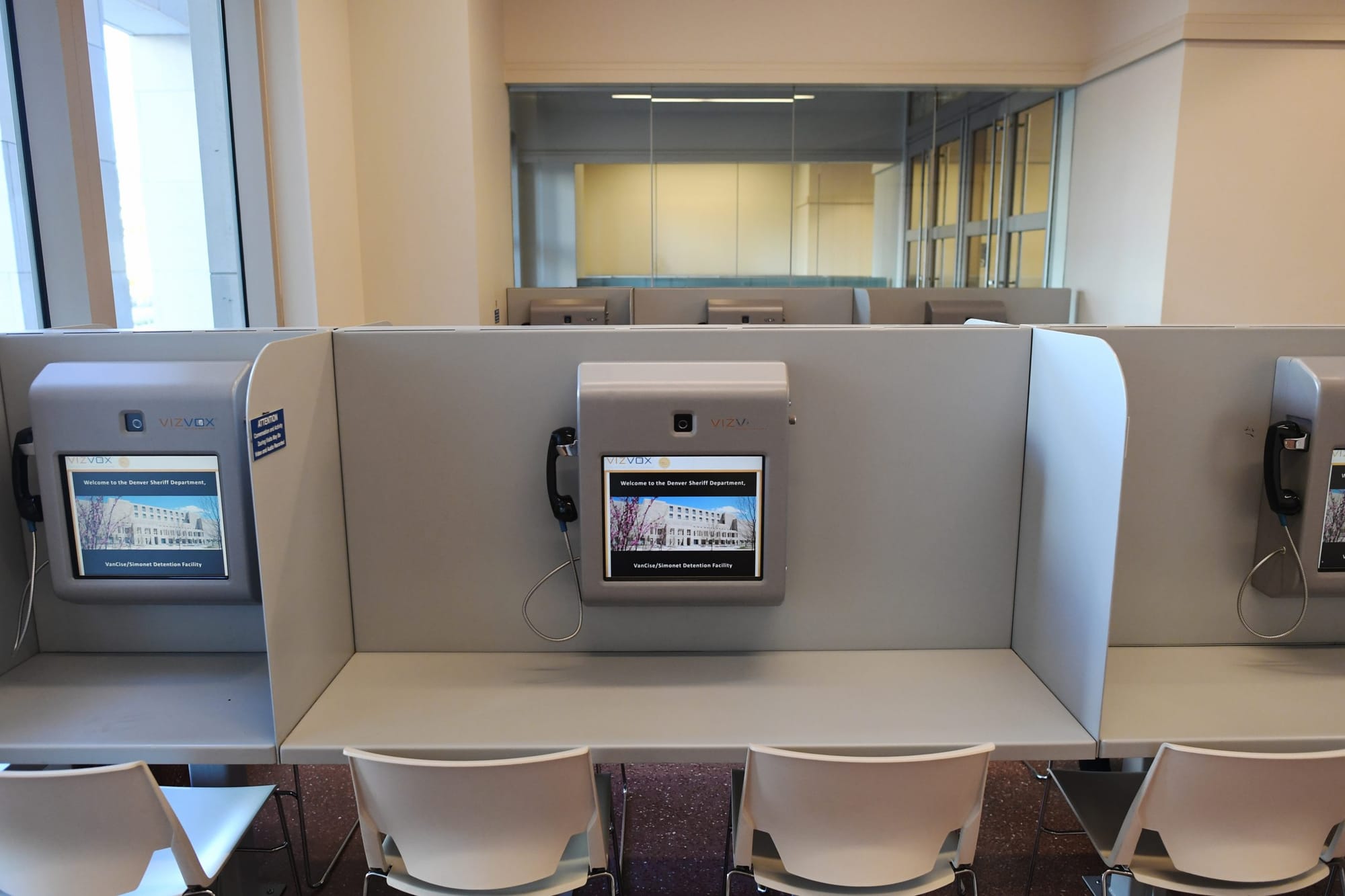
ViaPath, Aventiv, and similar companies charge incarcerated people and their loved ones exorbitant fees for prison phone and video calls, while also paying sizable commissions to state prisons for offering these services. Prism previously reported on the industry’s pivot toward prison tablet providers that allow these companies to generate revenue from digital messaging and media, on top of the large amounts of money they make from phone and video calls.
ViaPath and Aventiv are privately held, but previous reports from S&P Global indicate that each had more than $1 billion in debt as of 2024. Still, public records requests obtained by Prism offer a glimpse into how much the companies make and pay to state prisons.
Between September 2024 and August 2025, Securus Technologies, part of Aventiv, paid the Texas Department of Criminal Justice over $29 million in commission on phone call, video visitation, and e-messaging sales, according to records obtained by Prism. In another example, between January and September 2025, ViaPath generated $1.06 million in revenue from incarcerated people in South Dakota Department of Corrections custody and paid the state more than $161,000 in commissions, records show.
Aventiv and ViaPath have funneled a small portion of their revenues to various charities. In its 2024 impact report, Aventiv noted that it gifted nearly $250,000 to charitable causes, including $25,000 to the American Red Cross and $25,000 to ScholarCHIPS, a Washington, D.C.-based nonprofit that provides scholarships to children with incarcerated parents, according to a company press release. Meanwhile, the ViaPath Foundation has donated more than $400,000 to over 30 grantees since its founding in 2022, according to its website.
The funding ViaPath and Aventiv donate to communities impacted by incarceration amounts to a fraction of what they earn or pay in commissions to state prison systems.
In other words, the funding ViaPath and Aventiv donate to communities impacted by incarceration amounts to a fraction of what they earn or pay in commissions to state prison systems.
Under certain circumstances, private foundations qualify for tax exemptions, according to the IRS. The ViaPath Foundation received its exemption from federal income taxes in September 2022, according to an IRS letter sent to the foundation and obtained by Prism.
The ViaPath Foundation gave Comfort Cases, the nonprofit that gave a scholarship to Baker, a $10,000 grant in 2024 and another in 2025. Their relationship began after a ViaPath representative saw a video about Comfort Cases’ work and reached out to encourage the nonprofit to apply for a grant, said Rob Scheer, founder of Comfort Cases. The ViaPath grant enabled the company to expand their reach and increase the number of care packages the organization could send to youth in foster care, he said.
The ViaPath Foundation specified how many packed bags for Comfort Cases to send and where to send them, he added. Beyond the donations, ViaPath Foundation representatives have also participated in Comfort Cases packing parties, in which volunteers pack bags with essentials for foster youth.
With regard to the controversy surrounding ViaPath Technologies’ business practices, Scheer said he had only interacted with the ViaPath Foundation and that supporting children remains a bipartisan cause.
“My political beliefs are my political beliefs. I don’t bring them within my organization, because I don’t care whether your money’s from the red side or the blue side,” Scheer said. “I just want you to give because it impacts kids.”
Other nonprofits either weren’t aware of the controversy surrounding prison telecom companies such as ViaPath, or they felt that the company’s business practices weren’t cause for concern.
Similar to Comfort Cases, the ViaPath Foundation’s relationship with Big Brothers Big Sisters of the National Capital Area (BBBSNCA) extended beyond a donation.
The ViaPath Foundation granted $10,000 to the Washington, D.C. mentoring nonprofit in 2024 and provided gifts to children served by the nonprofit during the last holiday season. Representatives of ViaPath also previously volunteered to help the children make walkie-talkies, said Sylvia Gutierrez, chief program officer at BBBSNCA.
When asked whether the nonprofit had concerns about ViaPath’s business practices before accepting the funds, Gutierrez declined to comment.
In reference to donations from Aventiv Technologies, a spokesperson for the American Red Cross told Prism, “The American Red Cross is grateful for all advocates of our mission. Our lifesaving work wouldn’t be possible without donors and volunteers.”
ScholarCHIPS, another Aventiv donation recipient, provides scholarship and mentorship opportunities to young people with incarcerated parents. The organization’s founder and executive director, Yasmine Arrington Brooks, expressed concerns about her nonprofit’s current fundraising struggles before saying she did not want to get “caught in any crossfire.” Ultimately, she declined to be interviewed.
In 2022, Foster Love, another ViaPath grant recipient that helps foster youth in the U.S., Canada, and the U.K., was encouraged to apply for a grant by Shirley Moore Smeal, board chair of the ViaPath Foundation. According to Gianna Mulkay, executive director of Foster Love, the nonprofit has since received grants from the foundation that support multiple programs.
Given that the ViaPath Foundation provided support to Comfort Cases, another foster care-focused organization, Foster Love felt comfortable pursuing a relationship with the foundation, Mulkay explained.
“We don’t take money from specific organizations that do specific things like gambling, alcohol, etc., just because of the nature of the work we do,” Mulkay said. “But I think they didn’t demonstrate anything to me in our conversations that were red flags.”
Some ViaPath and Aventiv’s grantees told Prism that they have accepted funds from the telecom companies due to fundraising challenges.
Teacher’s Pet, a nonprofit that pairs shelter dogs with at-risk youth in Michigan’s Detroit metro area, received $12,000 from the ViaPath Foundation last year. Besides providing the funding, a foundation representative visited the nonprofit to see its work firsthand, said Jennifer Cepnick, vice president of Teacher’s Pet.
Amy Johnson Binder, executive director of Teacher’s Pet, initially told Prism that she wasn’t aware of the controversy surrounding ViaPath’s business practices. Binder later said the organization would not accept donations from entities whose values didn’t align with theirs, such as an electric collar manufacturer.
“I don’t know. I don’t know what it costs to run their business,” Binder said. “People are still benefiting from their services. That didn’t feel like an ethical violation in any kind of way. Like, how do you prove that I’m trying to gouge you and take advantage of you? So I never looked at it that way.”
While tablets have provided incarcerated people with more ways to communicate with their loved ones and entertain themselves, the cost of paying for tablet services, along with long customer service delays, puts financial and emotional strain on incarcerated people, previous reporting by Prism has shown.
When reviewing details about the grant and ViaPath Foundation, Cepnick noted that ViaPath’s philanthropic arm appeared to be aware of its sister company’s reputation, but the foundation wanted to donate to Teacher’s Pet to expand its program to more people.
Finding philanthropic or federal grant funding for a juvenile justice organization such as Teacher’s Pet can be a challenge, Cepnick said, because funders don’t want to “give to kids … who they think are doing bad things. But at the end of the day, these are kids.”
“When that opportunity … came up, I was reading about ViaPath. They understand what the justice system is and what it isn’t,” Cepnick continued. “I think they got it just because of the work they do outside of the foundation.”
Paying the price
Amid their philanthropic push, ViaPath and Aventiv are urging the Federal Communications Commission (FCC) to increase the maximum amount their companies can charge for phone and video calls.
In July 2024, the FCC lowered the caps on prison and jail phone calls from between 14 cents and 21 cents a minute to between 6 cents and 12 cents per minute, depending on the facility’s type and population. For video calls, which weren’t previously capped, prison telecom companies could charge no more than 25 cents per minute.
Under these Biden-era rules, prison telecom providers were also barred from paying site commission payments for incarcerated people’s communications services.
Three months after the caps were reduced, attorneys general from 14 states sued the FCC in response.
“Kickbacks were one of the factors that were actually driving rates up before,” said Wanda Bertram, communications strategist for the Prison Policy Initiative, a nonprofit focused on exposing the harms of mass incarceration. “Rather than eat the cost of providing a kickback to their contract partners, the companies would just raise the rates to make that cost neutral for them.”
Under the Trump administration, the FCC reversed course, allowing the previous exorbitant rates to stand, citing the “negative, unintended consequences” of the lower rate caps, implying that they were so low that telecom companies could not afford to provide services to prisons.
The Biden-era caps didn’t result in the widespread shutdown of any services, said Caroline Cohn, staff attorney at the National Consumer Law Center, an organization focused on stopping exploitative business practices.
“I don’t think they had the record to back up the claim that this was resulting in serious ‘unintended consequences,’” Cohn said. “It seems to be them bowing to the interests of the telecom companies.”
Bianca Tylek, founder and executive director of the prison abolition organization Worth Rises, attributes the FCC’s policy reversal to lobbying efforts from prison telecom companies and the National Sheriffs’ Association, the latter of which was particularly invested in increasing phone and video call rate caps to increase the commissions prisons receive.
If the FCC increases the caps for prison phone and video call charges, the call volume in one year could plummet by two-thirds, Worth Rises estimated in a report. Beyond the strain those costs would impose on incarcerated people and their families, the impact of that drop in communication would also reverberate throughout society, Tylek said.
“It’s also important for sort of the public good, including public safety, family unity, rehabilitation, because when people are connected to their loved ones, they are more likely to engage in programming to come home and stay home,” Tylek said.
Prison telecom giants’ donations to nonprofits are an attempt to rebrand their image by targeting charities that are often struggling to get funding, Tylek explained. Accepting these donations also allows others working in similar fields to perceive prison telecom companies as good actors.
Often people do not really appreciate how much harm these companies are causing and haven’t even bothered to look into it.
Bianca Tylek, founder and executive director of Worth Rises
Though the donations ultimately support people in need, accepting these funds from prison telecom companies “lacks integrity, but it also lacks analysis,” Tylek said. “I think often people do not really appreciate how much harm these companies are causing and haven’t even bothered to look into it.”
Jessica Artz, board vice chair of the ViaPath Foundation and executive vice president and chief human resources officer at ViaPath Technologies, declined to comment on ViaPath Technologies’ business model. However, she did tell Prism that the foundation’s goal is an extension of the company’s, which she said aims to facilitate affordable communication and engagement.
“We all see the articles that come out,” Artz said. “The industry as a whole is not viewed favorably. And I’m not going to be able to fix that. And the foundation might not be able to fix that, but what we can do is we can continue and always make sure that we have our mission for both the foundation and ViaPath at the heart of everything that we do.”
According to 990s reviewed by Prism, ViaPath Technologies—the sole contributor to the foundation—grew its foundation contributions from $35,000 in 2022 to $126,038 in 2024. The foundation plans to give more in the future, Artz said, adding that the number of applicants for its most recent grant cycle surged year-over-year, from 44 to 457.
As prison telecom providers push for favorable FCC regulations and funnel a minuscule portion of their revenues into charities, incarcerated people such as Patricia Trimble are paying the price.
Trimble, a trans author and activist incarcerated in the Missouri Department of Corrections (MDOC), regularly adds $50 worth of phone time to her Securus account. Per quarter, she estimated that she uses between 50 and 75 “stamps” that allow her to send messages to loved ones outside. Fifty digital stamps cost $12.50, according to a screenshot shared by Trimble.
In addition to the $10 she receives from the state for basic necessities and scant royalties from her book, she also receives a quarterly stipend from Black and Pink. The Omaha, Nebraska-based prison abolition nonprofit helps her pay for her phone minutes and digital stamps, Trimble explained on a crackling Securus phone call.
As the FCC, the industry, and advocacy groups engaged in a regulatory tug-of-war, the call rates for people incarcerated by MDOC fluctuated, Trimble recalled. Before Jan. 1, 2025, phone calls cost 5 cents per minute, but Securus lowered the cost to 2 cents per minute after Jan. 1, 2025, according to Trimble. The rates later increased to 5 cents per minute, which is what incarcerated people at MDOC now pay.
While Trimble has some income, most incarcerated people develop side hustles or depend on money from their friends and family on the outside, Trimble said.
“Back when it was 2 cents a minute, I talked two and a half times longer for that same nickel,” she said. “Black and Pink gives me a stipend, but when that runs light, then it comes out of my pocket. And without that, I can’t do interviews. I can’t do the multitude of things that I do on a daily basis. So for me, it would be devastating if they raised the rates much higher than the 5 cents a minute they’re currently charging.”
Upon learning the news that Securus’ parent company, Aventiv, donates to nonprofits, Trimble questioned the company’s motives.
“I’m sure, in all honesty, that doing that is for them simply a tax write-off,” Trimble said. “I’m positive they’re not just doing it out of the kindness of their heart.”
Editorial Team:
Tina Vasquez, Lead Editor
Lara Witt, Top Editor
Rashmee Kumar, Copy Editor
Tatiana Walk-Morris
Filed Under: