Despite flooding and drama at the polls, Florida saw high voter turnout
Most voters said Election Day went smoothly, but some campaign workers reported harassment and intimidation
Alexandra Martinez
Real journalists wrote and edited this (not AI). Independent, community-driven journalism survives because you back it. Donate to sustain Prism’s mission and the humans behind it.
Amelia Rangel had been canvassing outside Vizcaya Museum & Gardens in Miami for barely a day when a bald man stepped out of a black SUV and walked toward her.
Rangel, a Venezuelan immigrant who has lived in Miami for two years, was holding a large sign urging voters to reject Miami’s Referendum 3, a proposal to lease the Rickenbacker and Marine Stadium marinas on Virginia Key to a developer. She doesn’t speak much English. But she understood two words: “Go home.”
A campaign worker standing next to her translated the rest. The man, Rangel said, was offering her $100 to throw away her sign and leave.
“I started having heart palpitations right then and there,” Rangel told Prism. “I was scared because, well, I’m an immigrant, and with everything we’re going through right now, it’s not easy.”
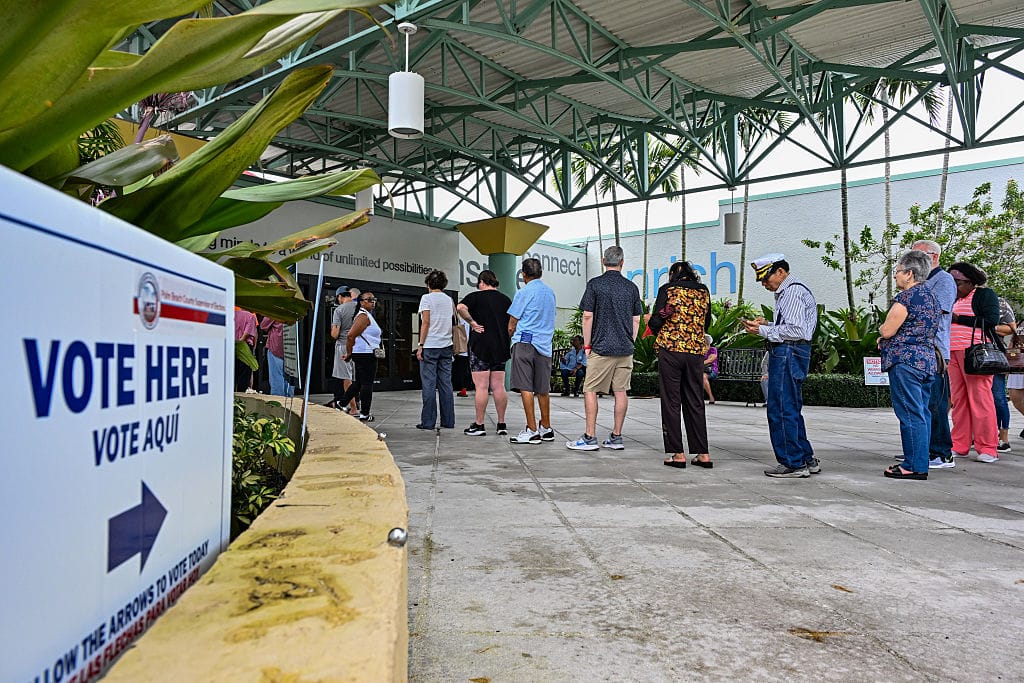
Rangel’s account, from the Oct. 20 early-voting period, was one of several stories Prism heard from community members gathered at Miami-Dade polling sites on Election Day, Nov. 3. Most voters said casting a ballot went smoothly, and Florida reported the second highest midterm turnout in three decades. But the day was not seamless.
Severe weather disrupts voting across Florida
In the days before the election, a stalled weather system dumped record rain on the state’s Atlantic coast. Palm Beach Gardens recorded about 17 inches in six hours on Nov. 1, a so-called 1,000-year rain event, and more than 26 inches fell near Melbourne in 24 hours on Monday.
Gov. Ron DeSantis declared a state of emergency on Nov. 2 for several counties, allowing local election supervisors to designate new polling places where sites were damaged or roads were unsafe. By Election Day, officials had moved 21 polling places serving 30 precincts across eight counties, with Brevard and St. Lucie counties hit hardest.
Despite the disruptions, Florida recorded relatively high voter participation in the 2026 midterms. Approximately 8.3 million Floridians cast ballots, bringing statewide turnout to 60.9%, the second-highest midterm turnout in the state in 30 years, according to the News Service of Florida. Turnout was approximately seven percentage points higher than in 2022, although it remained about two percentage points below the 2018 midterms.
A boombox outside the Miami Beach polls
In Miami Beach, the tension came from a candidate. Republican state Rep. Fabián Basabe, seeking a third term in House District 106, spent part of Election Day outside a polling place with a portable speaker playing a recorded message attacking his Democratic opponent, Lucia Báez-Geller.
The recording asked why Báez-Geller, a former Miami Beach Senior High English teacher and Miami-Dade School Board member, wasn’t there “speaking for herself.” It also demanded a debate and described the campaign against Basabe as “a coordinated political hit job.”
Temi Oguns, canvassing for Báez-Geller, said Basabe set the speaker up beside him about two hours before he spoke with Prism.
“He’s playing that intentionally to make sure that people don’t hear what I’m saying,” Oguns said. He said he hadn’t seen intimidation, just “regular political animosity,” and that it didn’t bother him.
Basabe declined to answer Prism’s questions at the polling site because he said he only does live interviews. “You journalists are too affordable,” he said.
The polling-place standoff capped a run of confrontations. Three days before the election, Basabe approached Miami-Dade Mayor Daniella Levine Cava while she was eating at a diner near Miami Beach City Hall, Florida Politics reported. Christian Ulvert, Levine Cava’s political adviser, called it “a stunt meant to rattle a public servant”.
At the polls on Election Day, voters told Prism that they didn’t feel intimidated. Several hadn’t noticed Basabe at all.
“On the contrary, I was welcomed,” said Eduardo Sanchez, a Miami Beach resident. What he expects from a polling place, he said, is “respect and confidential treatment,” and for everyone “to feel welcome and just make their choice.”
A poll worker serving as a clerk at the site said they weren’t aware of Basabe’s activity but pointed to anti-intimidation and harassment signs posted at the location. “If that happens here, it’s not tolerated,” the clerk said, adding that it is illegal to intimidate or harass poll workers.
In July, a civil jury found Basabe liable for sexual harassment, battery, and defamation and awarded $450,000 to a former aide and a former intern, according to Florida Politics. The Miami Beach City Commission unanimously censured him, and five of its seven members called on him to resign.
On Nov. 3, Basabe lost to Báez-Geller.
Tempers also ran high over Miami's Referendum 3. “Vote No” canvassers said early voting at Vizcaya brought heated standoffs between the two sides. Canvasser Anna Quiroz said things calmed down after her campaign called out the behavior, and that Election Day at Elizabeth Virrick Park in Coconut Grove was quiet. Voters rejected the referendum with more than 65% of the vote.
A recount and questions about who runs it
In Florida’s 27th Congressional District, Republican Rep. María ElviraSalazar led Democrat Eliott Rodriguez 50.22% to 49.78%, within the 0.5-point threshold that triggers a mandatory machine recount.
On Nov. 6, Rodriguez sued to remove Miami-Dade Supervisor of Elections Alina Garcia from overseeing the recount. His campaign pointed to her ties to the Republican Party, past remarks praising President Donald Trump, her election-night declaration of Salazar as the likely winner, and her son-in-law’s role on Salazar’s legal team, according to the Miami Herald. Garcia’s daughter, Alyn Fernandez, works at RHF Law Firm, which represents Salazar, while her husband, Robert Fernandez, is the firm’s managing shareholder.
Garcia refused to recuse herself saying the process was transparent. Robert Fernandez defended the process as fair and open to the public. Salazar called her lead insurmountable and accused Rodriguez of behaving like an election denier.
Rodriguez countered, “A recount is not a denial of an election result or a challenge to democracy.”
On Nov. 9, an hour before the machine recount began, U.S. District Judge David S. Leibowitz denied Rodriguez’s request to remove Garcia from the canvassing board.
At the hearing, Leibowitz called Garcia’s election-night declaration to the Herald, that Salazar had won whether or not there was a recount, “a really dumb statement to make.” But he found the allegations weren’t enough to force her off the board. Garcia is one of three canvassing board members, he noted, and the other two are local judges, so she couldn’t decide the outcome alone.
The national picture
The National Coalition on Black Civic Participation brought together more than 40 organizations, including the NAACP and Common Cause, in an Election Day command center that monitored Black voter turnout, documented intimidation and other barriers, and connected voters with the nonpartisan Election Protection hotline.
Common Cause said Election Day went relatively smoothly, crediting months of preparation, nearly 30,000 volunteers in 44 states and D.C., and more than 15,000 voter calls on Election Day alone. “Democracy didn’t hold,” said Virginia Kase Solomón, the group’s president and CEO. “We made it hold.”
State leaders described a newer source of tension: election monitors with the Department of Justice (DOJ). In New Mexico, 10 DOJ monitors in Bernalillo County questioned voters and poll workers until election officials asked them to move on, said Common Cause Director Molly Swank in a post-election briefing.
Shifting rules
The Local Solutions Support Center flagged 162 election-related bills in 37 states during the 2025-26 sessions. Most stalled, but 15 became law, several of them banning ranked-choice voting.
Columbia Law School professor Richard Briffault, who reviewed the bills for the group, called the changes fairly modest. Recently, Florida, South Dakota, and Utah passed state versions of the Safeguard American Voter Eligibility Act (SAVE) Act, the Trump-backed federal bill requiring proof of citizenship to register and photo ID to vote that died in the Senate. Last year, North Dakota, Utah, Ohio, and Kansas ended grace periods for mail-in ballots that arrive after Election Day.
The push for these bills rests on fraud claims that haven’t held up, Briffault said; noncitizen voting is vanishingly rare and usually a mistake. “In order to get at the nonexistent voter fraud problem, they’ve been adopting rules that just make it harder to register and harder to vote,” Briffault said. Eligible voters can be dropped from the rolls, and less engaged voters may give up, he said.
Given the size of the Democratic wave, he said, the effect this year is hard to measure. “We just don’t know.”
In Florida, the rules are about to tighten. HB 991, which DeSantis signed in April, will require new citizenship checks for registration applicants and create an “unverified voter” category.. Most provisions take effect Jan. 1, 2027. The state will check registrations against government databases and remove voters who don’t respond to a mailed notice within 30 days; Briffault warned that those databases are often unreliable and may not reflect recent naturalizations. The law also bars student IDs, debit and credit cards, and several other kinds of ID at the polls. Voting rights groups have sued, WUSF reported.
Voters elsewhere weighed in directly. According to Common Cause, Arizona and Colorado voters rejected measures that would have made voting harder, and Massachusetts voters approved Election Day registration.
“Research and consider both sides”
Back at Elizabeth Virrick Park on Election Day, Quiroz, the Vote No canvasser, had a message for voters that had little to do with the marina.
She urged people to spend 10 or 20 minutes reading up on unfamiliar ballot items, and to not simply follow the endorsements of people they admire. “Even Democrats can have different views on a certain amendment,” she said, “as well as Republicans.”
“Take a moment to reflect,” she said, on “what’s best for the city and what’s best for the people.”
Alexandra Martinez