Filed Under:
Struggling families in Gaza turn to child labor to survive
Amid the genocide, children are picking up work, sometimes as the sole providers for their families
Hassan Abo Qamar
Real journalists wrote and edited this (not AI). Independent, community-driven journalism survives because you back it. Donate to sustain Prism’s mission and the humans behind it.
I woke early one morning to the sounds of neighborhood children playing soccer loudly outside our house in Gaza. I washed my face and prepared to yell at them at the top of my lungs to go play somewhere else. Then, I remembered: These were the children’s only few hours of freedom before heading off to exhausting work. Whether chasing water trucks to fill gallon-containers with clean drinking water, standing in food charity lines, or carrying heavy aid packages on their backs, these children were responsible for bringing hard-earned income to their families amid the genocide.
At an age when they are supposed to be sitting inside classrooms, hundreds of thousands of children in Gaza remain deprived of in-person education. According to the latest United Nations statistics, most school-aged children in the Strip—approximately 658,000 children—have had extremely limited access to face-to-face learning for more than two academic years.
In our neighborhood, the financial situation is far from good for most families. Although we are in Al-Nuseirat and still living in our homes, the economic situation has become unbearable for everyone, especially since most residents used to survive on daily wages. Once the genocide halted most businesses and commercial activity, many people found themselves sitting at home without work or with jobs that barely provided enough to survive.
This reality has pushed many families to allow their children to work, either to increase the household income or to force children to become responsible for themselves at an early age. If a child craves chocolate or a bag of chips—what are now considered “luxuries” most families cannot afford—the child must go out and earn the money to purchase them on their own.
Yousef’s story
The children of Gaza have been stripped of their most basic rights and even their smallest dreams. Yousef Abu Al-Khair is one of the neighborhood’s children—perhaps its loudest—and one of many children forced to grow up too early. Yousef has spent his days, from noon until evening, searching for any opportunity that could bring a little money home, he told Prism.
Yousef, 14, does not work to buy chocolate or a new pair of football shoes. He works to become the sole provider for a family of seven.
His income is meant to replace his parents’. His father has severe psychological disorders that prevent him from working or interacting with people. His mother, who tried to help by working as a cleaner, was fired during her pregnancy and forced to stay home to care for her younger children.
Before the genocide, Yousef, whom I’m known for years, was committed to school, loved football, and dreamed of succeeding in his favorite hobby: breakdancing. But despite being considered one of the best trainees in a local breakdance team, he was forced to abandon it after the genocide began because it required long hours of practice.
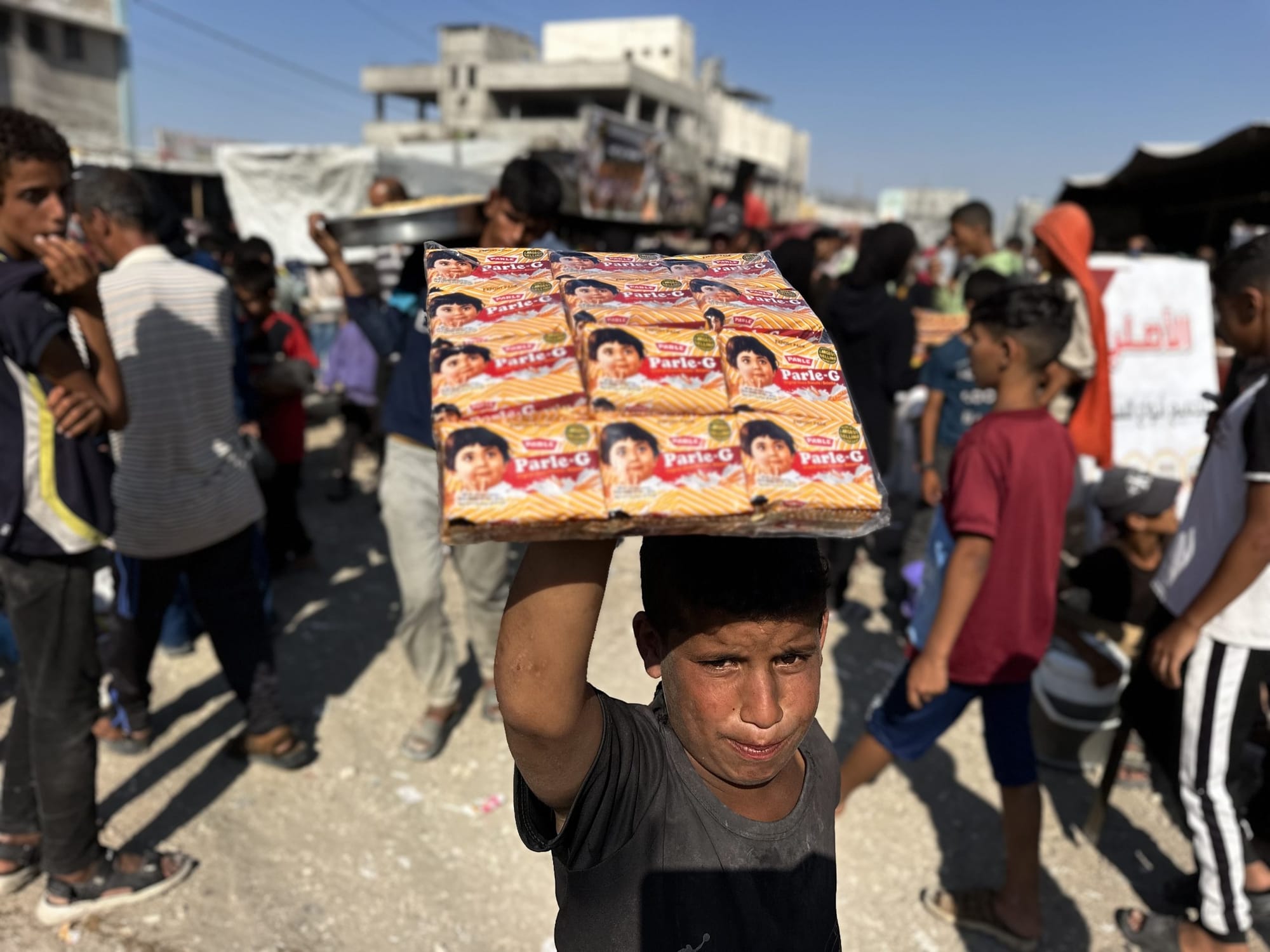
After the genocide began, I would often see Yousef moving from one job to another. Sometimes he bought boxes of cookies from local shops to resell in the market for a tiny profit of no more than 4 shekels per box, a little over $1. Other times, he sold homemade cookies prepared by his mother whenever ingredients were available at home. Often, he stood near aid distribution points, offering to carry aid boxes to elderly people’s homes for 4 shekels, after such work became a common source of income for children in Gaza.
But it did not stop there. During periods of famine, Yousef would leave home at midnight and remain until the early hours of dawn near the Gaza Humanitarian Foundation’s “death traps,” hoping to secure a place in the flour or aid lines. He would return carrying whatever he managed to obtain—flour, sugar, rice, or bulgur—depending on what was available.
Yousef’s grandmother, Maisar Abu Al-Khair, told me that Yousef suffers from chronic respiratory problems and regularly depends on an inhaler, while his younger brother has heart problems.
On one occasion, thieves threatened Yousef with knives and forced him to hand over the aid he was carrying, including a box of instant noodles he had brought for his 3-year-old sister, Jeneen, from the American aid distribution points. Abu Al-Khair said she could see the heartbreak and helplessness on Yousef’s face afterward.
“Their situation is completely desperate,” she said of Yousef’s family. “Yousef has been carrying responsibilities far beyond his age.”
Struggling children and orphans
In Gaza, average wages for physically demanding jobs, such as restaurant work or loading goods, barely exceed $1 per hour, even for young men between 20 and 30 years old, according to interviews with workers. As for children working at street stalls or temporary jobs, most return home after a full day of labor with no more than 20 shekels, less than $7.
More than 97% of Gaza’s schools have been damaged or destroyed. Despite attempts by international organizations such as UNICEF and UNRWA to provide alternative learning spaces, these efforts remain insufficient compared to the scale of the educational catastrophe in Gaza. UNICEF has established spaces in 78 educational centers serving around 109,310 children, 54% of them girls, through non-formal education programs. Children attend these centers only three days a week for three hours a day because of overcrowding and limited capacity.
Child labor and school dropouts have become expected consequences in Gaza amid limited aid and the staggering rise in the number of orphans: At least 53,724 children have lost at least one parent, while 2,596 children have lost both.
One of the most prominent institutions attempting to support these children is Al-Amal Institute for Orphans, founded in 1949 immediately after the Nakba.
Despite the harsh conditions, the institute continues to provide various services for orphans, including education through its kindergarten and the Al-Amal Educational School, educating more than 1,000 orphaned children in different shifts, according to board member Najlaa Al-Ghalayini.
In addition, the institute’s residential care section shelters more than 100 orphaned children, admitted only after careful case assessments, Al-Ghalayini said.
“Each child in the residential section receives shelter, food, clothing, educational services, and psychological and social support, in an attempt to preserve what remains of Gaza’s children’s childhood,” Al-Ghalayini said.
As the genocide continued, the institute also transformed into a humanitarian refuge for orphaned children who were displaced alongside their mothers, grandparents, or relatives. Today, it hosts more than 200 orphan families, in addition to hundreds of displaced families spread across its facilities.
“The stories we received during the genocide are beyond description,” Al-Ghalayini said. She said some children told staff that they were trapped beneath the rubble for days without food or water, while others had watched their parents bleed to death before their eyes without being able to help. Some children lost contact with relatives because of repeated displacement, Al-Ghalayini said.
“These stories cannot be counted or summarized; they are permanently engraved in the memory of Gaza’s children,” she said.
The psychological and social burdens are especially heavy on girls, Al-Ghalayini said.
“Young girls became mothers to their siblings, responsible for housework, teaching younger brothers and sisters, fetching water, and securing daily necessities,” she said. “These are burdens no child should ever carry.”
A vulnerable existence
Since the beginning of the war, 71,803 Palestinians in Gaza have reportedly been killed, including at least 21,289 children, while 171,230 Palestinians have been injured, among them 44,500 children. Experts estimate that the true toll is likely much greater. More than 120 children have also reportedly been killed since the beginning of the so-called ceasefire in Gaza.
Every child in the Gaza Strip, from premature infants to teenagers approaching adulthood, remains vulnerable to death, whether through Israeli bombardment, while playing among buried unexploded remnants of Israeli bombs, or because of the harsh living conditions in every aspect of daily life.
Even those who survive are forced to live under crushing fear and anxiety that make life feel like hell. Many children in Gaza now sit beside street stalls selling tissues or cookies, or lighting fires for their mothers to cook food, instead of sitting in classrooms.
These children have abandoned dreams of becoming astronauts, global stars, or even pilots in a land with no exits, replacing them with far simpler and crueler dreams: to live a life where they have a family that protects and embraces them during every bombardment, to eat whatever they crave whenever they want, or simply to buy new clothes for Eid.
These are basic rights they have been denied, despite having committed no crime worthy of having their childhood and sense of safety stolen from them—except for being born Palestinian.
Editorial Team:
Sahar Fatima, Lead Editors
Lara Witt, Top Editor
Rashmee Kumar, Copy Editor
Hassan Abo Qamar
Filed Under: